
Skip to content
Dandelion Psychotherapy
DandelionPsychotherapy

Resources

Transactional analysis diagrams

These are the diagrams transactional analysis (TA) is usually taught with, drawn from scratch by Dandelion Psychotherapy, the online practice of psychotherapist Yoshita Bhargava. Each one has a short explanation, its original source, and SVG and PNG files to download.

You can use them in slides, handouts, theses, blog posts and books, commercial ones included, under the Creative Commons Attribution 4.0 licence. Credit Dandelion Psychotherapy with a link to the diagram; each one has an HTML credit and an APA reference you can copy. The models belong to the people who first described them, so cite them too.

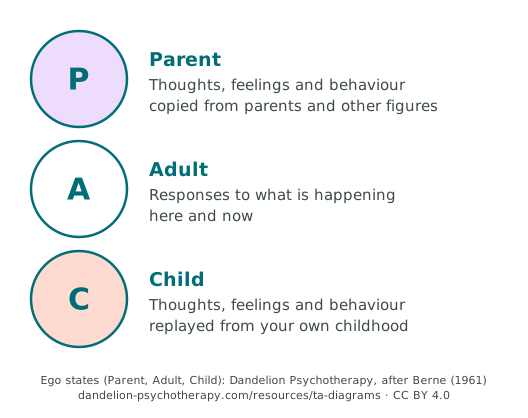
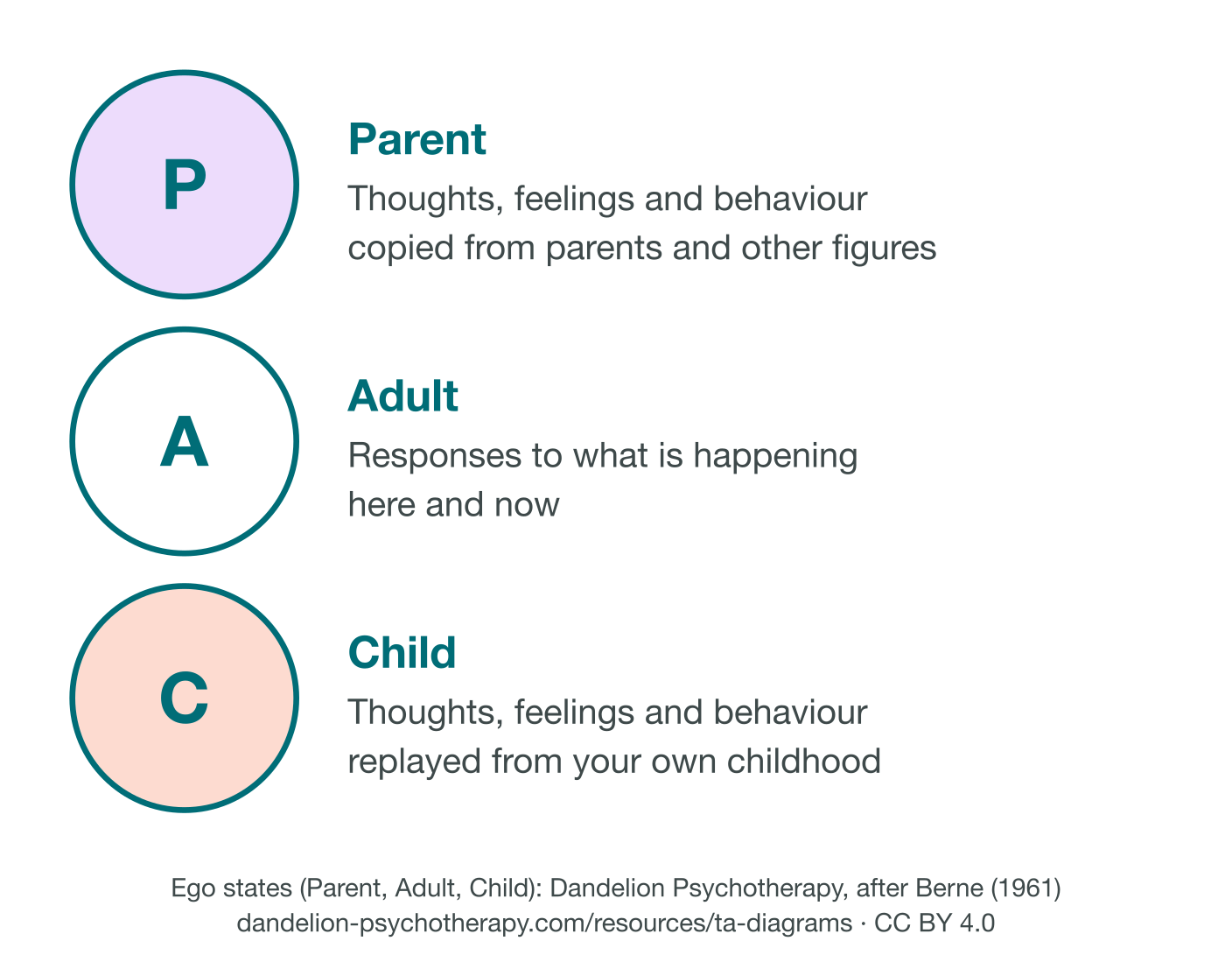
Berne's structural model: three stacked circles for the Parent, Adult and Child ego states, with what each containsPParentThoughts, feelings and behaviourcopied from parents and other figuresAAdultResponses to what is happeninghere and nowCChildThoughts, feelings and behaviourreplayed from your own childhood
The structural model (Berne, 1961): what each ego state holds and where it came from.

Ego states (Parent, Adult, Child)

After Berne (1961)

Eric Berne divided personality into three ego states. The Parent holds what you took in from parents and other important adults, the Adult deals with what is happening now, and the Child is your own childhood replayed, with its old feelings and old ways of reacting. Everyone has all three, and the one in charge can change from minute to minute.

The three ego states, in the TA guide
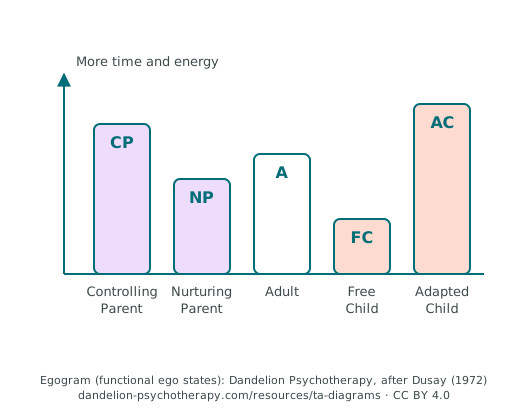
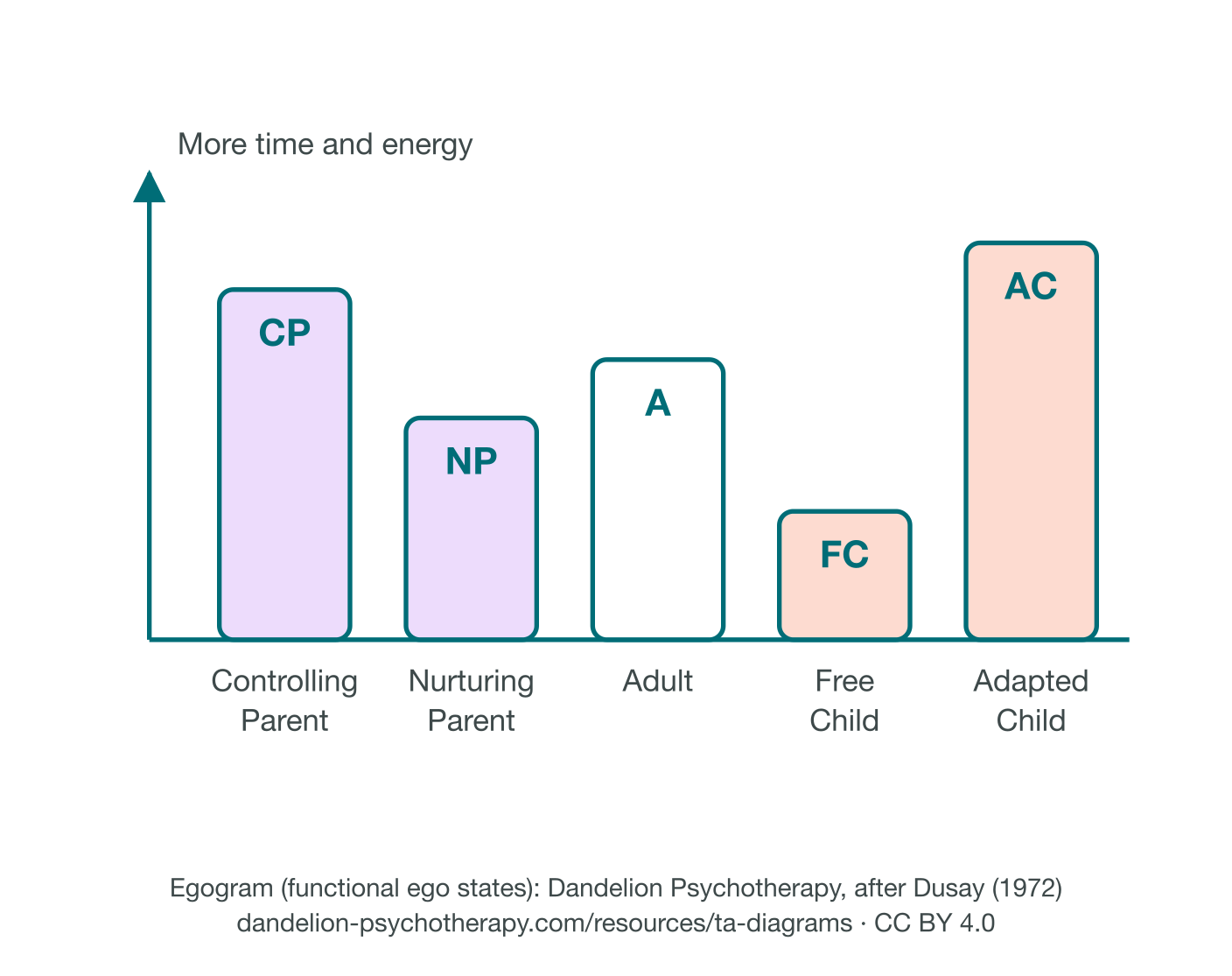
An egogram: a bar chart of the five functional ego statesFive bars for one example person. Controlling Parent: high. Nurturing Parent: middling. Adult: middling. Free Child: low. Adapted Child: high.More time and energyCPControllingParentNPNurturingParentAAdultFCFreeChildACAdaptedChild
An egogram, after John Dusay (1972). The bar heights are one invented profile, an estimate of time and energy, not a measurement.

Egogram (functional ego states)

After Dusay (1972)

John Dusay drew the five functional ego states as bars: Controlling Parent, Nurturing Parent, Adult, Free Child and Adapted Child. Each bar is a rough guess at how much of your time and energy goes into that way of behaving, so the chart is for talking about balance and isn't a test score. Dusay's constancy hypothesis says that when one bar grows, another shrinks. The heights here are one invented profile.

Ego states, in the TA guide
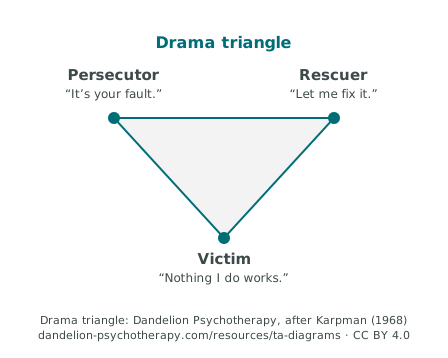
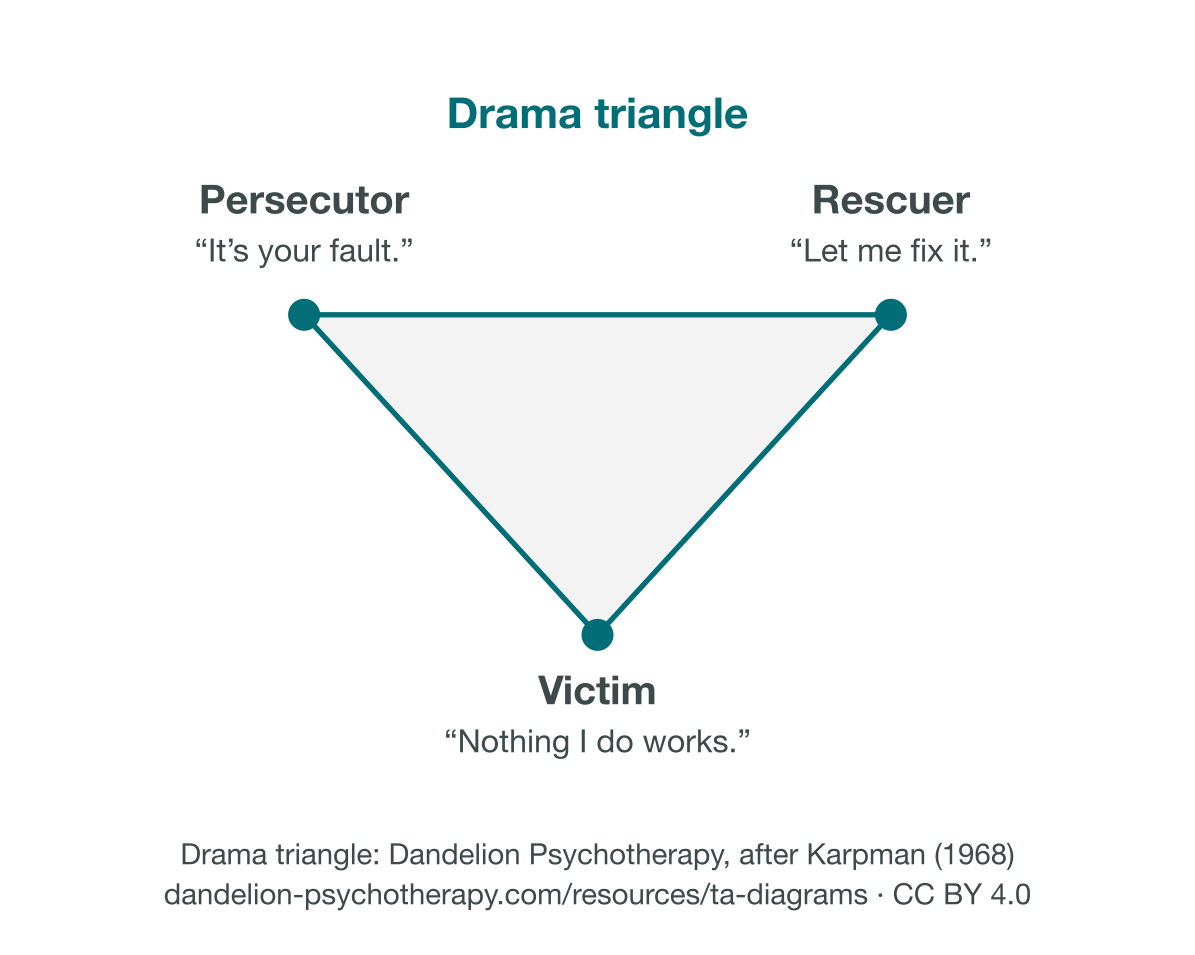
Karpman's drama triangle: Persecutor, Rescuer and VictimA triangle with Persecutor at the top left (it's your fault), Rescuer at the top right (let me fix it) and Victim at the bottom (nothing I do works).Drama trianglePersecutor“It’s your fault.”Rescuer“Let me fix it.”Victim“Nothing I do works.”
The drama triangle, after Stephen Karpman (1968).

Drama triangle

After Karpman (1968)

Stephen Karpman mapped three roles that people take up in a conflict that keeps repeating: Persecutor, Rescuer and Victim. He started from fairy tales, where the drama comes when a character changes role, as when the rescued victim turns on the rescuer. In real life that switch is often the moment a conversation goes sour.

The drama triangle, explained
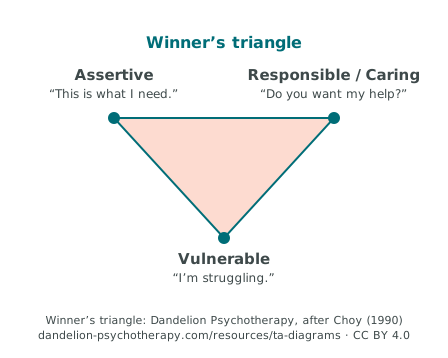
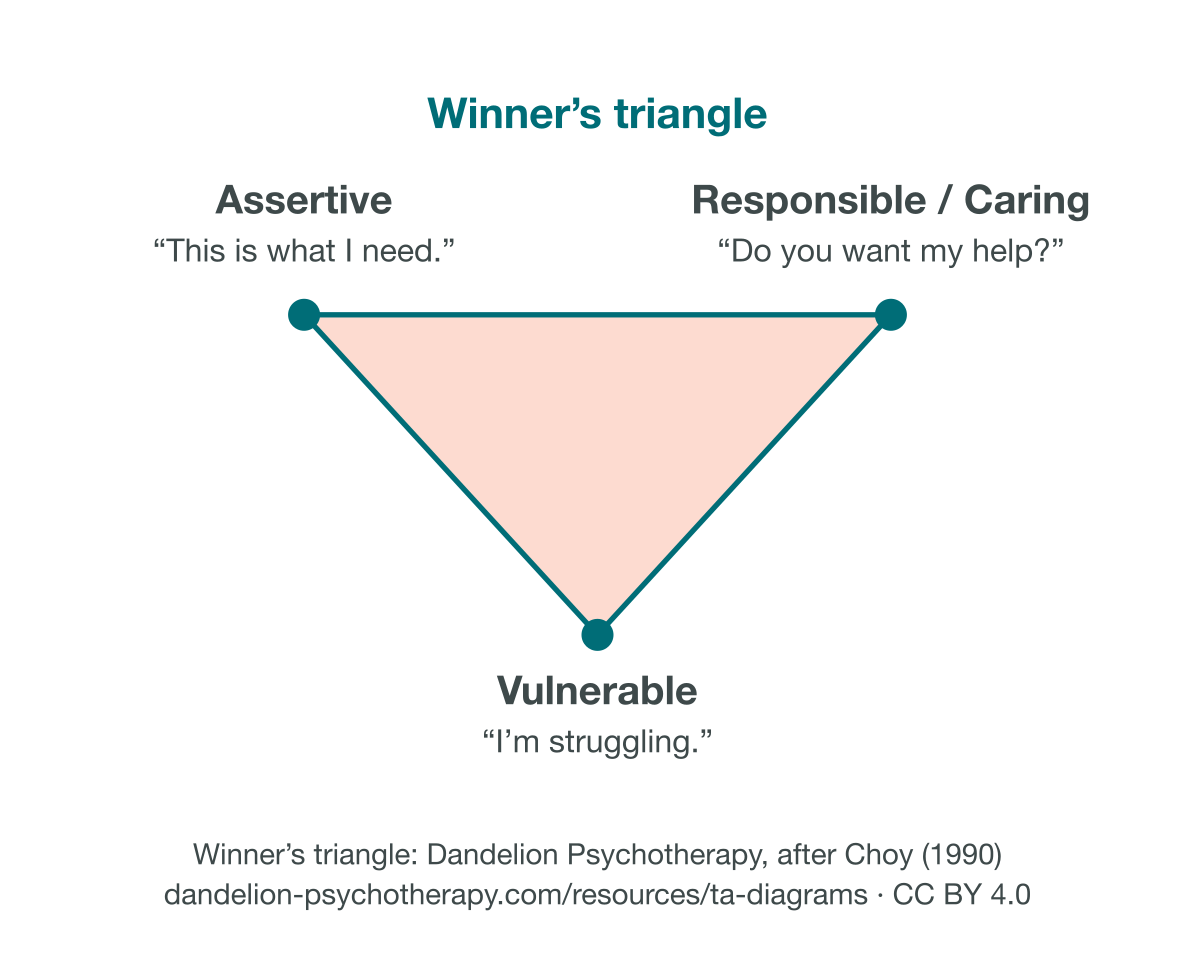
Choy's winner's triangle: Assertive, Responsible and VulnerableA triangle with Assertive at the top left (this is what I need), Responsible, also called Caring, at the top right (do you want my help?) and Vulnerable at the bottom (I'm struggling).Winner’s triangleAssertive“This is what I need.”Responsible / Caring“Do you want my help?”Vulnerable“I’m struggling.”
The winner’s triangle, after Acey Choy (1990). Each corner sits where its drama-triangle role sits.

Winner’s triangle

After Choy (1990)

Acey Choy proposed a way out of each drama role. The Victim becomes Vulnerable and says what is hard, the Persecutor becomes Assertive and asks for what they need, and the Rescuer becomes Responsible (some writers say Caring) and helps only when asked. The corners sit where their drama-triangle roles sit, so the two diagrams work side by side.

The winner’s triangle, in the drama triangle guide
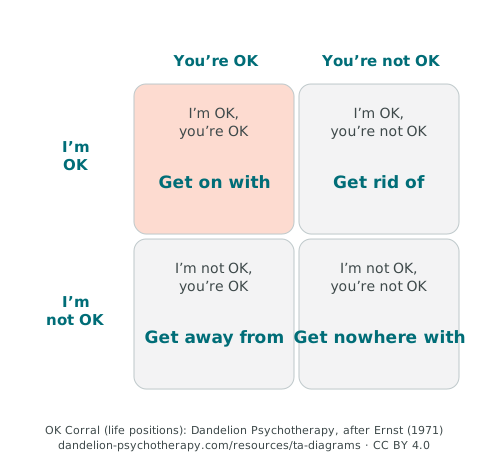
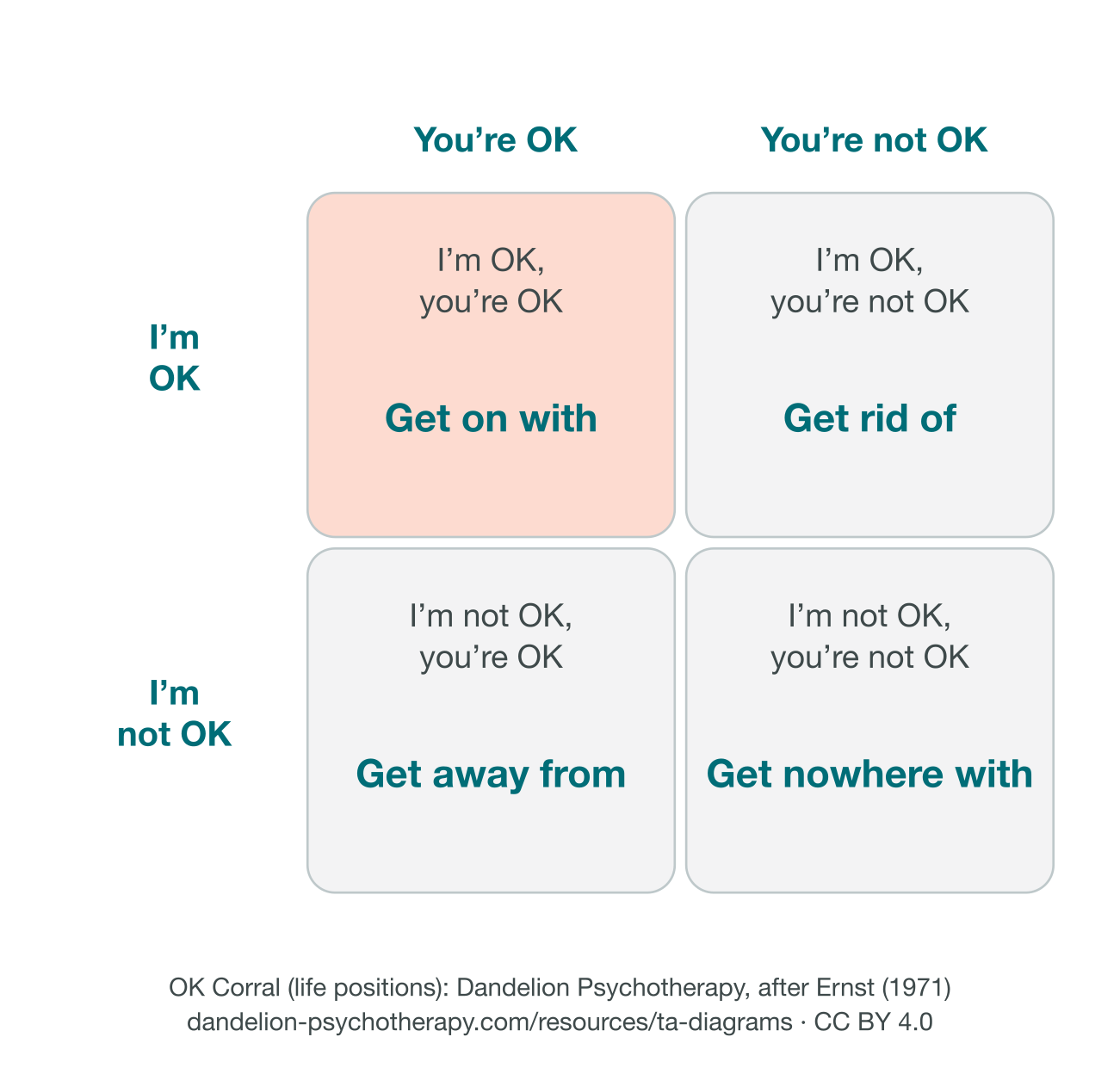
Ernst's OK Corral: the four life positions on a gridA two by two grid. I'm OK, you're OK: get on with. I'm OK, you're not OK: get rid of. I'm not OK, you're OK: get away from. I'm not OK, you're not OK: get nowhere with.You’re OKYou’re not OKI’mOKI’mnot OKI’m OK,you’re OKGet on withI’m OK,you’re not OKGet rid ofI’m not OK,you’re OKGet away fromI’m not OK,you’re not OKGet nowhere with
The OK Corral, after Franklin Ernst (1971), with the operation he named for each life position.

OK Corral (life positions)

After Ernst (1971)

Berne described four life positions, the basic stance a person takes about their own worth and other people's. Franklin Ernst put them on a grid and named what each one leads you to do with other people: get on with them, get rid of them, get away from them, or get nowhere with them. People move around the grid during a day, and under stress most fall back to one familiar corner.

Life positions, in the TA guide
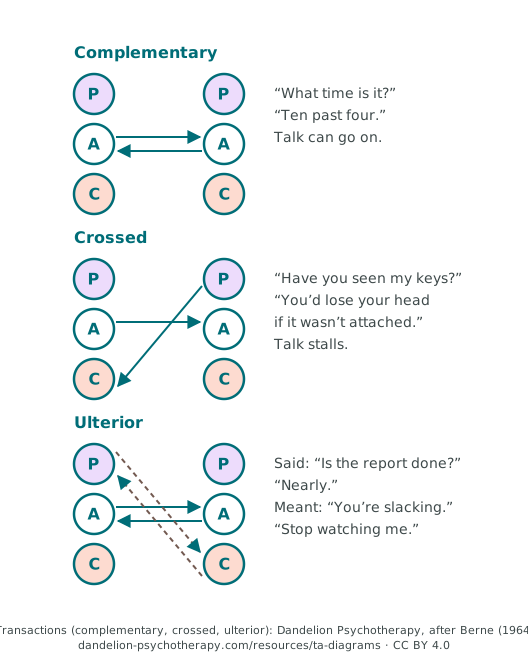
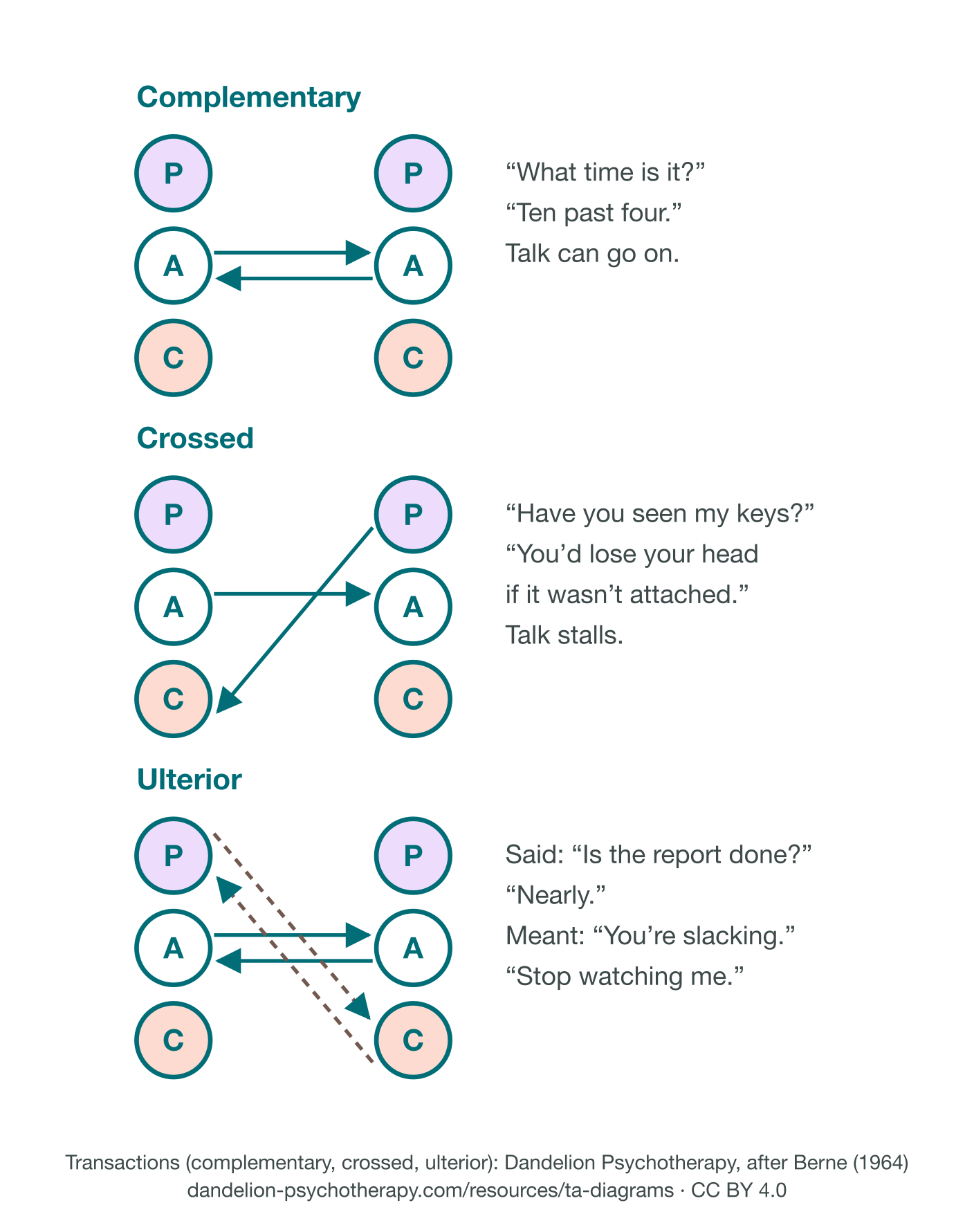
Three kinds of transaction: complementary, crossed and ulteriorComplementary: Adult to Adult and back, the lines run parallel, as in what time is it, ten past four. Crossed: the question goes Adult to Adult but the reply comes from Parent to Child, as in have you seen my keys, you'd lose your head if it wasn't attached. Ulterior: a spoken Adult to Adult exchange about whether the report is done, with a hidden Parent to Child and Child to Parent exchange underneath, drawn as dashed lines.ComplementaryPPAACC“What time is it?”“Ten past four.”Talk can go on.CrossedPPAACC“Have you seen my keys?”“You’d lose your headif it wasn’t attached.”Talk stalls.UlteriorPPAACCSaid: “Is the report done?”“Nearly.”Meant: “You’re slacking.”“Stop watching me.”
Complementary, crossed and ulterior transactions, after Eric Berne (1964). Solid lines are what is said; dashed lines are the hidden message.

Transactions (complementary, crossed, ulterior)

After Berne (1964)

A transaction is one exchange: something one person says and the other's reply, each coming from an ego state. If the reply comes from the ego state that was spoken to, the lines run parallel and the talk can carry on. If it comes from another one, the lines cross and the conversation stalls. In an ulterior transaction a hidden message runs under the spoken one, and Berne held that the hidden one decides what happens next.

Transactions, in the TA guide
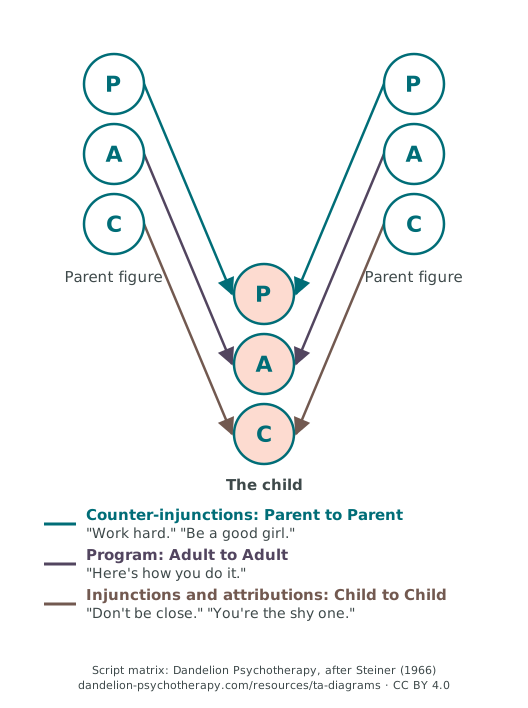
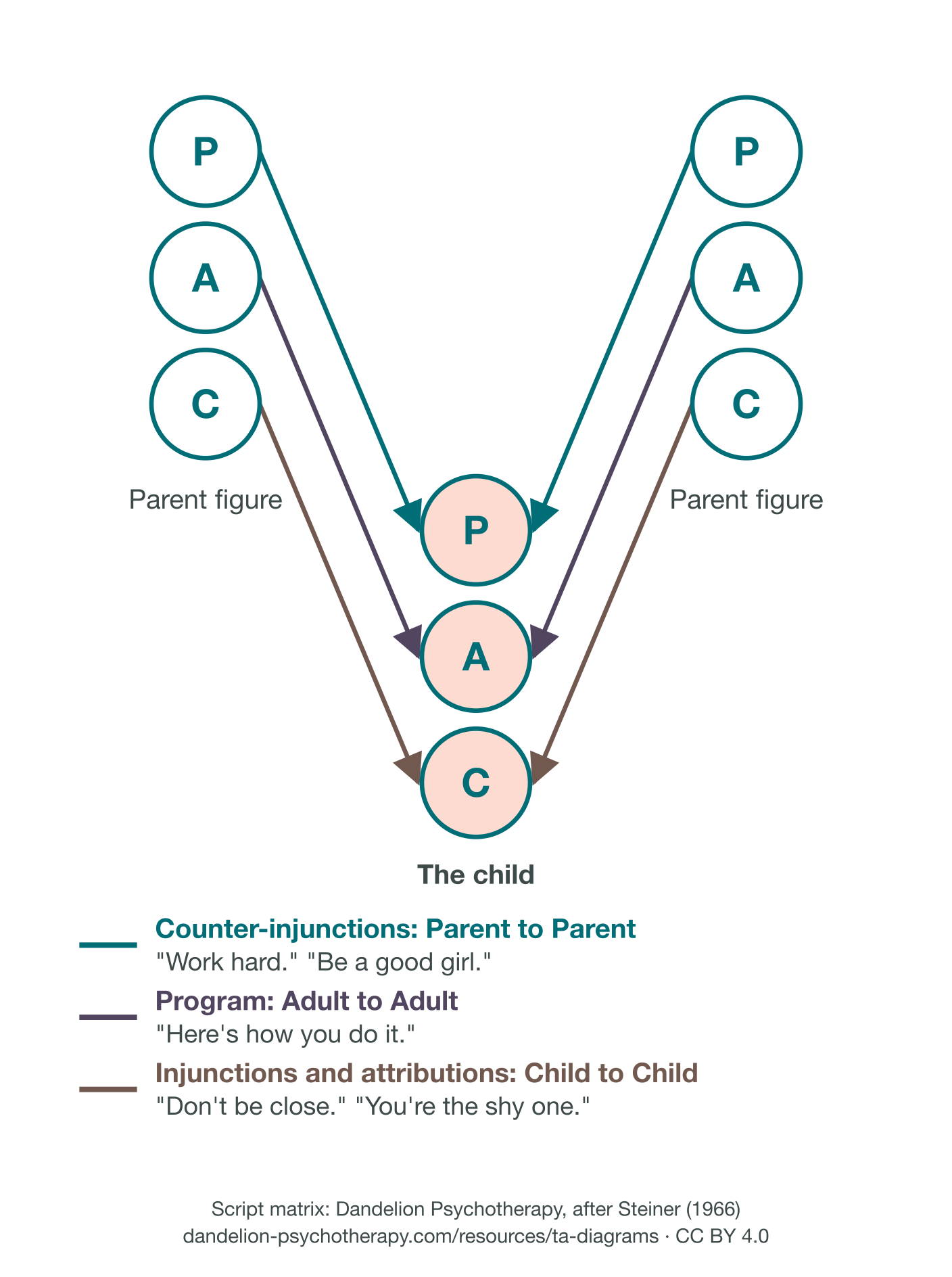
Steiner's script matrix: two parents each pass messages from their Parent, Adult and Child ego states to the same ego states in the childPACParent figurePACParent figurePACThe childCounter-injunctions: Parent to Parent"Work hard." "Be a good girl."Program: Adult to Adult"Here's how you do it."Injunctions and attributions: Child to Child"Don't be close." "You're the shy one."
The script matrix, after Claude Steiner (1966). Each parent figure sends messages from all three ego states.

Script matrix

After Steiner (1966)

Claude Steiner's script matrix shows a child taking in a life script from two parent figures. Spoken rules such as “work hard” pass from Parent to Parent and practical know-how from Adult to Adult. Injunctions such as “don't be close” pass from the parent's Child to the child's Child, usually without anyone saying them out loud.

Life scripts in TA
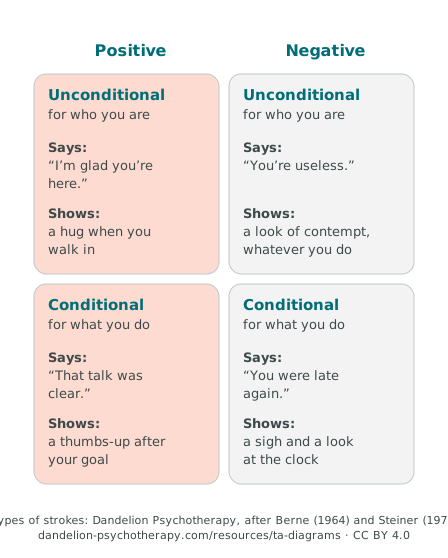
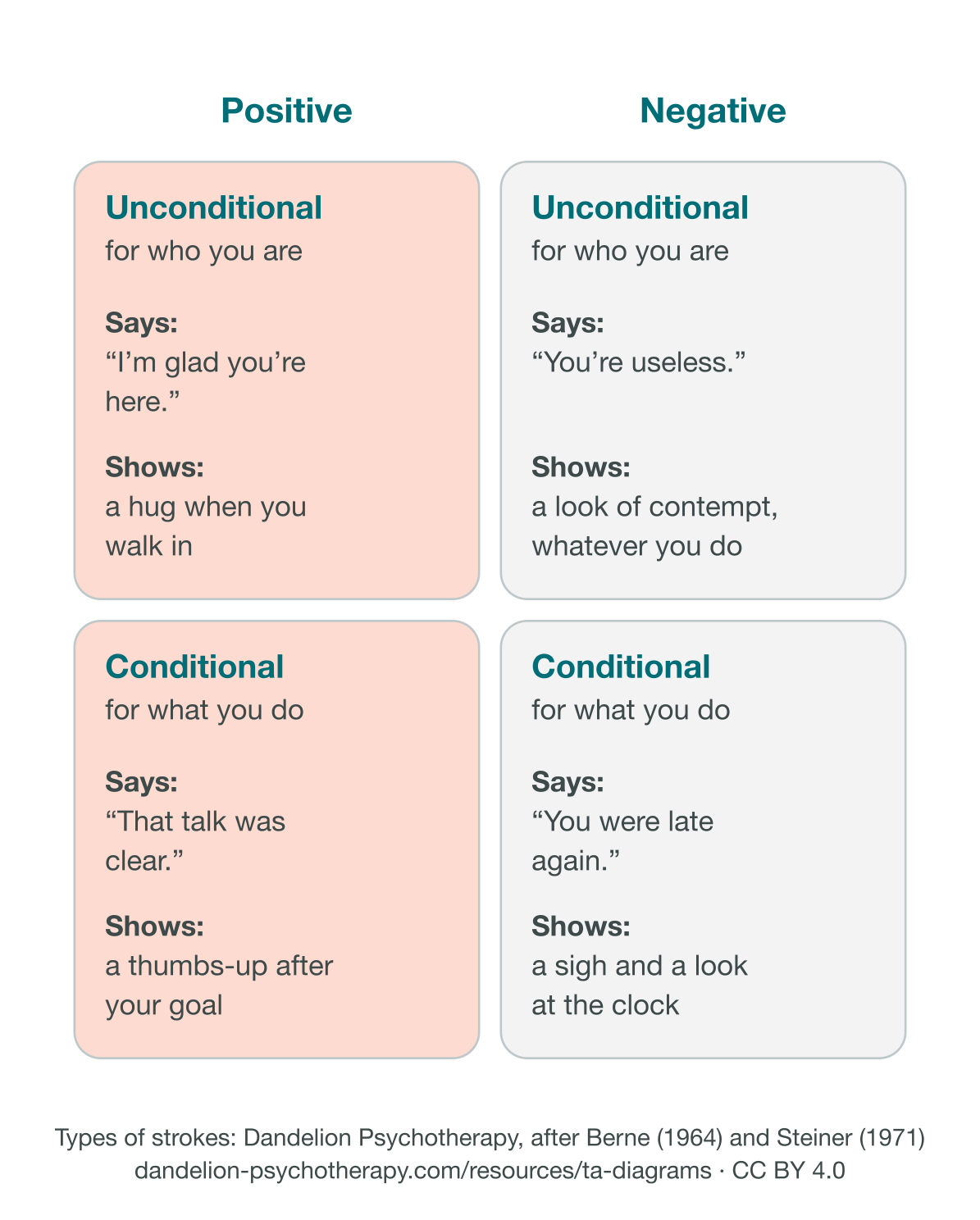
Examples of strokes: positive or negative, unconditional or conditionalA two by two grid. Positive unconditional: saying I'm glad you're here, or a hug when you walk in. Negative unconditional: saying you're useless, or a look of contempt whatever you do. Positive conditional: saying that talk was clear, or a thumbs-up after your goal. Negative conditional: saying you were late again, or a sigh and a look at the clock.PositiveNegativeUnconditionalfor who you areSays:“I’m glad you’rehere.”Shows:a hug when youwalk inUnconditionalfor who you areSays:“You’re useless.”Shows:a look of contempt,whatever you doConditionalfor what you doSays:“That talk wasclear.”Shows:a thumbs-up afteryour goalConditionalfor what you doSays:“You were lateagain.”Shows:a sigh and a lookat the clock
Spoken and unspoken examples of each kind of stroke, after Berne (1964) and Steiner (1971). All four count as recognition.

Types of strokes

After Berne (1964) and Steiner (1971)

A stroke is TA's word for any act of recognition. Strokes are positive or negative, and unconditional (for who you are) or conditional (for what you do), and the grid gives a spoken and an unspoken example of each. TA holds that people would rather have negative strokes than none, which helps explain why some painful patterns keep going.

Strokes in TA
Want to explore therapy together?

These resources reflect the philosophy behind the practice. If something resonates, reach out.

Book a Free Intro Call