
Life Scripts in Transactional Analysis and the Script Matrix
By the Dandelion Reflect team
Last updated:
What a life script is in transactional analysis: Berne's idea, Steiner's script matrix, winning and losing scripts, the six script types and how scripts change.
TL;DR: In transactional analysis (TA), a life script is the life plan a person starts writing in early childhood and then mostly forgets they wrote. Eric Berne saw it as the result of decisions a child makes in order to survive. Claude Steiner's script matrix (1966) shows how a script is put together from messages each parent sends from their Parent, Adult and Child ego states. Berne sorted scripts by outcome (winning, losing and non-winning) and by how they unfold over time (six script processes). Because a script rests on decisions, TA holds that it can be decided again.
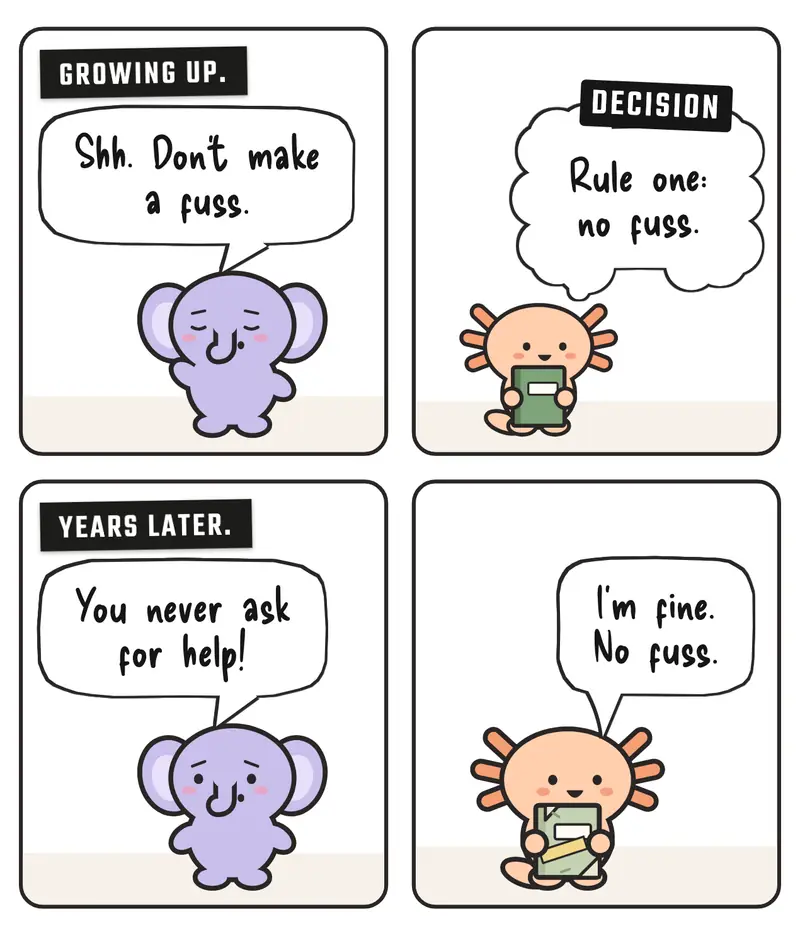
A life script, in transactional analysis, is an unconscious plan for how your life will go, written when you were small. A child watches what happens around them, hears what is said and what is left unsaid, and draws conclusions about themselves ("I'm too much"), about other people ("people leave") and about the world ("you have to earn your place"). Those conclusions turn into a storyline, and the adult tends to keep acting it out, ending included. If TA is new to you, start with what transactional analysis is. This guide covers where scripts come from, Steiner's script matrix, the kinds of script Berne and Steiner described, and how therapy works with them.
What Is a Life Script in Transactional Analysis?
Eric Berne, the psychiatrist who founded TA, took the word from the theatre. The International Transactional Analysis Association (ITAA) sums up his idea like this: Berne "proposed that dysfunctional behavior is the result of self-limiting decisions made in childhood in the interest of survival", and those decisions add up to "the pre-conscious life plan that governs the way life is lived out" (ITAA). He set out the theory in full in his last book, What Do You Say After You Say Hello? (1972).
A few features of a script matter more than the rest.
- It is made in childhood. TA writers usually place the main script decisions in roughly the first seven years (Stewart & Joines, TA Today, Lifespace, 2012).
- The child decides it. Parents send messages, but the child decides what to make of them. Two siblings in the same house can write very different scripts.
- Later events seem to confirm it. Once a child has decided "nobody listens to me", they notice every time it happens and miss the times it doesn't.
- It runs out of awareness. Most adults can't say what their script is. What they notice are the repeats: the same kind of partner, the same way of leaving jobs, the same flat feeling after good news.
Later TA writers kept the idea and argued with parts of it. In a 1988 critical review written from a developmental point of view, William Cornell put it bluntly: "Script theory has become more restrictive than enlivening." He argued that it placed "primary emphasis on psychopathology rather than on psychological formation" (Cornell, 1988, p. 281, quoted in English, 1988). Fanita English, replying the same year, agreed with the thrust of his critique. Richard Erskine, whose work on life scripts earned the 2018 Eric Berne Memorial Award (Erskine, 2019), describes a script as a complex set of unconscious relational patterns, built from early survival reactions, conclusions and decisions (Erskine, Life Scripts, Karnac, 2010).
Where a Script Comes From
Three ingredients go into a script.
Messages. Some are spoken: "Big boys don't cry." "Always come first in class." Many more are shown: a parent who goes quiet when the child is excited, or who only looks up when the marks are high. TA calls the unspoken "don't" messages injunctions. Bob and Mary Goulding described twelve of them (Goulding & Goulding, 1976).
Attributions. Labels a child is given and then grows into: "She's the sensible one." "He's just like his uncle." A child who hears often enough that they are the shy one may decide that shyness is who they are.
Decisions. The child's own conclusion about what all this means and how to get by. The Gouldings put the decision at the centre: a message shapes a script only when a child decides to go along with it. That is the hopeful part of script theory, because a decision can be made again.
Culture adds a layer of its own. Marco Mazzetti has written about Berne's interest in cultural scripts, the storylines a community or country passes on to its members (Mazzetti, 2010). "What will people say?" is a script message in many Indian families, and families in plenty of other countries would recognise it.
The Script Matrix: How Messages Travel
In 1966 Claude Steiner, one of Berne's early colleagues, published the diagram that became the standard way to draw a script (Steiner, "Script and counterscript", Transactional Analysis Bulletin, 1966). It is called the script matrix. It shows two parent figures and a child, each drawn as three stacked ego states: Parent, Adult and Child.
Messages travel along three channels.
- Counter-injunctions, from Parent to Parent. The rules said out loud: "Work hard." "Don't make a fuss." "Be good." Together they make up the counterscript. Taibi Kahler's five drivers, Be Perfect, Please Others, Be Strong, Try Hard and Hurry Up, are its core.
- The program, from Adult to Adult. How to do things: how to cook, how to argue, how to handle money, how to get through a bad day. A parent shows the child how to live the script out, usually without meaning to.
- Injunctions and attributions, from Child to Child. The heavier, mostly wordless messages, which come out of the parent's own fears and wants. A parent who was frightened of their own anger can pass on "Don't feel" without saying a word.
Counter-injunctions are louder, but TA writers generally treat injunctions as the stronger of the two, because they are taken in earlier and with more feeling (Stewart & Joines, 2012). When the two clash, say "Be successful" from a parent's Parent and "Don't make it" from the same parent's Child, a person may drive hard toward a goal and then stall just short of it.
Who makes the decision? TA calls the inventive, intuitive part of a young child the Little Professor, the Adult inside the Child (labelled A1 in Berne's diagrams). It reads the room and works out a strategy with the limited information a four-year-old has. That is why script decisions can look odd to an adult and still make sense from where the child stood.
Fanita English added a darker twist with the episcript. She described how a parent, or anyone in a one-up position, can pass a feared fate on to a more vulnerable person, like the children's game where whoever holds the hot potato when the music stops pays a penalty. The person who passes it on behaves as if they can get rid of their own fears or guilt by handing them to someone else. Berne suggested the name, and he published her first paper on it in 1969 (English, 1969; English, 1996).
Winning, Losing and Non-Winning Scripts
Berne sorted scripts by how they turn out, and he chose plain words on purpose (Berne, 1972).
- Winning scripts. A winner, for Berne, is someone who achieves what they set out to achieve. The goal can be small or large.
- Losing scripts. The person doesn't reach the goal, or reaches it and then loses it. Berne graded losing scripts by how serious the ending is, from repeated small disappointments up to real harm.
- Non-winning scripts. The person never quite loses and never quite wins. They get by, break even and say "at least nothing bad happened."
Claude Steiner later called the ordinary, undramatic kind of script banal, to set it apart from tragic scripts that end in disaster (Steiner, Scripts People Live, Grove Press, 1974).
Few people have a pure version of any of these. Most have areas of life where they win without much fuss and others where they keep stopping short. The labels describe a script's direction. They aren't a verdict on a person.
Steiner's three banal scripts
In Scripts People Live, Steiner argued that most scripts are banal, and that they grow out of three kinds of early training: lovelessness (learning to go without love and closeness), mindlessness (learning not to trust your own thinking) and joylessness (learning to lose touch with your body and its pleasure). He saw all three as shaped by society as well as by parents.
The Six Script Processes
Berne also noticed that scripts have a typical shape in time, a way the plot unfolds. He described six of these script processes and illustrated most of them with stories from Greek myth and legend (Berne, 1972).
- Never. Tantalus stood in water under branches of fruit that moved away whenever he reached for them. The person never gets the thing they most want, and often never starts toward it.
- Always. Arachne was condemned to weave forever. The same thing happens again and again, often by moving from one bad situation to a very similar one: "Why does this always happen to me?"
- Until. Something good has to wait until something else is done. "I'll rest once the children are settled." "I'll start living when I've lost the weight."
- After. Damocles feasted with a sword hanging over his head by a single hair. Enjoying something now means paying for it later: "A good day today means a bad one tomorrow."
- Over and Over. Sisyphus pushed his boulder almost to the top of the hill, again and again. The person gets close, then slips back. TA writers also call this process Almost.
- Open-ended. After a certain point, such as retirement or the children leaving home, the plot runs out and the person doesn't know what happens next.
Most people recognise more than one of these in themselves. They are common patterns, not diagnoses.
How Scripts Show Up in Adult Life
You can't see your own script directly, but you can see where it shows.
- An ending that keeps repeating across different relationships or jobs.
- A strong, familiar bad feeling that turns up at the same point in the story, such as being let down or left out.
- A sentence about yourself that sounds older than you: "I'm just not lucky." "I always have to do everything myself."
- Life stages that bring the script to the surface. Pamela Levin's developmental cycles describe how childhood tasks come round again in adult life.
The script also shows up in ordinary moments. Drivers appear in a few seconds of behaviour, and Berne saw psychological games as one of the main ways a script moves toward its ending.
A composite example, not a real person. Daniel, 41, has started three businesses. Each one grew well for a year and then folded after a decision he can't fully explain. His father, who was proud of him and also competitive with him, used to say "don't get above yourself" with a laugh. When Daniel draws his script matrix, he sees "Work hard" coming clearly from his father's Parent and something closer to "Don't make it" from his father's Child. The shape is Over and Over: up the hill, and back down.
How Therapy Works With Life Scripts
TA therapy starts with a contract, an agreement about what you want to change, in your own words. The ITAA describes TA practice as "based upon mutual contracting for change" (ITAA). Script work then tends to include a few strands.
- Script analysis. Mapping the messages, labels and decisions, sometimes by drawing your own script matrix.
- Spotting the script as it runs. Catching the driver, the familiar bad feeling or the repeated ending while it is happening.
- Redecision. The Gouldings combined TA with Gestalt methods so that a person can go back to the scene of an old decision and make a new one, using what they know and can do as an adult (Goulding & Goulding, Changing Lives Through Redecision Therapy, 1979).
- Practice. A new decision has to be lived as well as understood, so people try it out in small, real situations and notice what happens.
A script took years to build, and it usually loosens gradually. Seeing it clearly is an early step, and it often changes what feels possible. The page on Transactional Analysis therapy describes what TA therapy involves.
Reflective Questions, Not a Quiz
There is no score here. Notice which questions you would rather skip.
- What were you told you were like as a child? Which of those labels still fit, and which have you outgrown?
- Finish this sentence quickly: "People like me always..."
- What did your family say about success, money, love or leaving home? What did they show you?
- Is there an ending you keep arriving at, in work, friendships or love?
- Which of the six script processes sounds most like your last ten years?
- If your life were a film, what would the poster say? Would you want to watch it?
If thinking about your script brings up something heavy, including thoughts that life isn't worth living, please don't carry it alone. In India, Tele-MANAS (14416 or 1-800-891-4416) is the government's free tele-mental health line and runs 24x7. Outside India, contact your local emergency number or crisis line.
Frequently Asked Questions
What are life scripts in TA?
A life script is an unconscious life plan that a person starts writing in early childhood. Eric Berne saw it as the result of decisions a child makes in order to survive, which later events seem to confirm. It is built from parental messages, the labels a child is given and the child's own decisions, and adults tend to keep living it out until they become aware of it.
What is the script matrix in transactional analysis?
The script matrix is Claude Steiner's 1966 diagram of how a script is passed on. It draws two parent figures and a child, each as Parent, Adult and Child ego states. Counter-injunctions travel from Parent to Parent, the program from Adult to Adult, and injunctions and attributions from Child to Child.
What are winner, loser and non-winner scripts?
They are Berne's three outcomes. A winner achieves what they set out to achieve. A loser doesn't, or achieves it and then loses it. A non-winner gets by without big wins or big losses. Most people have a mix across different areas of life.
What is a banal script?
It is Claude Steiner's term for an ordinary, undramatic script that slowly narrows a life instead of ending in tragedy. In Scripts People Live (1974) he traced banal scripts to early training in lovelessness, mindlessness and joylessness.
Can you change your life script?
TA holds that you can. A script rests on decisions a child made with the information they had, and an adult can revisit those decisions. Script analysis helps you see the pattern, and approaches such as redecision therapy help you make a new decision and practise it.
If you'd like to look at your own script with a TA therapist, a free 15-minute intro call is a low-pressure place to start.
Sources
- What is transactional analysis? International Transactional Analysis Association.
- Berne E. What Do You Say After You Say Hello? The Psychology of Human Destiny. Grove Press; 1972.
- Steiner C. Script and counterscript. Transactional Analysis Bulletin. 1966;5(18):133-135.
- Steiner C. Scripts People Live: Transactional Analysis of Life Scripts. Grove Press; 1974.
- Goulding R, Goulding M. Injunctions, decisions, and redecisions. Transactional Analysis Journal. 1976;6(1):41-48.
- Goulding MM, Goulding RL. Changing Lives Through Redecision Therapy. Brunner/Mazel; 1979 (Grove Press edition, 1997).
- Cornell WF. Life script theory: a critical review from a developmental perspective. Transactional Analysis Journal. 1988;18(4):270-282.
- English F. Whither scripts? Transactional Analysis Journal. 1988;18(4):294-303.
- Erskine RG. The life script trilogy: acceptance speech on receiving the 2018 Eric Berne Memorial Award. Transactional Analysis Journal. 2019;49(1):7-13.
- Erskine RG, ed. Life Scripts: A Transactional Analysis of Unconscious Relational Patterns. Karnac; 2010.
- Mazzetti M. Eric Berne and cultural script. Transactional Analysis Journal. 2010;40(3-4):187-195.
- English F. Episcript and the "hot potato" game. Transactional Analysis Bulletin. 1969;8(32):77-82.
- English F. Berne, phobia, episcripts, and racketeering. Transactional Analysis Journal. 1996;26(2):122-131.
- Stewart I, Joines V. TA Today: A New Introduction to Transactional Analysis. 2nd ed. Lifespace; 2012.
Related writings
10 min read
The 5 Transactional Analysis Drivers, Explained
The 5 transactional analysis drivers (Be Perfect, Please Others, Be Strong, Try Hard, Hurry Up), how they ride on injunctions, and how therapy loosens them.
6 min read
12 Transactional Analysis Injunctions, With Examples
The 12 transactional analysis injunctions Bob and Mary Goulding described, from Don't Exist to Don't Feel: how each sounds, where it starts, how therapy helps.
8 min read
Cycles of Development: A Journey Through Your Stages
Pamela Levin's cycles of development, as Jean Illsley Clarke taught them: each stage's age and task, plus a questionnaire on what may still need your attention.
Talk to a therapist about this
Transactional Analysis is the main way Dandelion works with individuals. Here is what it looks like in practice.
Transactional Analysis therapyYou can also look at online individual therapy.