
Psychological Games in Transactional Analysis: 10 Examples
By the Dandelion Reflect team
Last updated:
Psychological games in transactional analysis: Berne's definition, Formula G, the three degrees of games and 10 games people play, with examples and ways out.
TL;DR: In transactional analysis (TA), a psychological game is a repeated series of exchanges with a hidden message underneath, which ends with the people involved feeling bad in a familiar way. Eric Berne described dozens of them in Games People Play (1964), with names like "Kick Me" and "Why Don't You, Yes But". In 1972 he summed up the moves of a game in Formula G: Con + Gimmick = Response, then Switch, Cross-up and Payoff. Games come in three degrees, from mild to dangerous. People don't play them on purpose, and once you can spot the switch, you can start to step out.
A psychological game, in TA, is a set of moves two people repeat without noticing. Something is said on the surface, something else is meant underneath, and the exchange ends with a switch and a bad feeling both of them have had before. Think of the friend who asks for advice and turns down every idea, or the argument that ends with the same slammed door every Sunday. If TA is new to you, start with what transactional analysis is. This guide covers Berne's definition, his Formula G, the three degrees of games and ten of the best-known games, each with an example, and what helps people stop playing.
What Is a Psychological Game in Transactional Analysis?
Berne's definition was: "A game is an ongoing series of complementary ulterior transactions progressing to a well-defined, predictable outcome" (Berne, 1964, quoted on the Eric Berne estate's site). In plainer words:
- Ulterior means two messages travel at once: the social one you can hear and a psychological one underneath. The TA guide's section on complementary, crossed and ulterior transactions explains the difference.
- Complementary means each person answers the hidden message the way the other invited, so the game keeps going.
- A predictable outcome means it ends the same way each time, with the same feelings.
The International Transactional Analysis Association (ITAA) describes games as "repetitive, devious transactions" that "are principally intended to obtain strokes but instead they reinforce negative feelings and self-concepts, and mask the direct expression of thoughts and emotions" (ITAA).
"Devious" can sound like an accusation, so one point needs saying plainly: games are played outside awareness. In TA terms, the Adult ego state doesn't know a game is under way. People aren't scheming. They are repeating a pattern that once brought them some recognition, or kept something worse away.
Berne said the whole idea started with one pattern. He wrote that "Why Don't You, Yes But" "occupies a special place in game analysis", and that "it was the original stimulus for the concept of games" (Berne, 1964).
Why People Play Games
TA gives several reasons, and they overlap.
- Strokes. A game reliably produces recognition, even when it's negative. A row is at least contact. The TA educator Piotr Jusik notes that when a group's hunger for strokes goes unmet, people start inviting games (Jusik, 2020). The guide to strokes and the stroke economy explains why negative strokes can feel better than none.
- Contact without closeness. Berne counted games among the ways people fill their time with others, alongside withdrawal, rituals, pastimes, activities and intimacy (Berne, 1964). Games bring plenty of contact while keeping real intimacy at arm's length.
- Confirming the script. The bad feeling at the end confirms an old belief, such as "people always let me down" or "I can't get anything right", and Berne saw games as one of the main ways a life script moves toward its ending.
- Predictability. A familiar bad ending can feel safer than an unfamiliar one.
Formula G: The Six Moves of a Game
In What Do You Say After You Say Hello? (1972), Berne set out a formula that he said every game follows:
C + G = R → S → X → P
- Con. The opening move, an invitation with a hidden message.
- Gimmick. The weak spot in the other person that the con hooks into, such as a need to help, to be right or to be liked.
- Response. The run of transactions that follows, which can look perfectly ordinary.
- Switch. Someone changes position, and the game turns.
- Cross-up. A moment of confusion: what just happened?
- Payoff. Each player's familiar bad feeling.
Berne treated the formula as a test. A pattern that fits it is a game. A repeated pattern without a switch, however unpleasant, is something else.
Stephen Karpman made the switch easier to see with his drama triangle (1968). The three roles are Persecutor, Rescuer and Victim, and the switch is the moment someone jumps from one corner to another. Karpman described a game as a simpler form of drama, usually with one major switch (Karpman, 1968).
The Three Degrees of Games
Berne graded games by how much harm they do (Berne, 1964).
- First-degree games are socially acceptable in the player's circle. People will happily tell the story at dinner.
- Second-degree games do no permanent harm, but the players would rather hide them.
- Third-degree games are played for keeps and end in serious harm, which Berne put bluntly as surgery, the courtroom or the morgue.
The same game can be played at different degrees, and Berne described several of his games at all three. TA writers have applied the degrees of games to domestic violence (Bicehouse & Hawker, 1993).
A note on abuse. Game analysis describes patterns people fall into together. It doesn't mean that someone who is being hit, threatened or controlled is "playing a game", and it never shifts responsibility for violence onto the person harmed. If you are in danger, the useful question is how to get safe. In India, call 112 in an emergency, and Tele-MANAS (14416 or 1-800-891-4416) is the government's free tele-mental health line, open 24x7. Outside India, contact your local emergency number.
10 Games People Play, With Examples
Berne sorted his games into life games, marital games, party games, sexual games, underworld games, consulting room games and a handful of "good games" (Berne, 1964). Here are ten of the best known. The examples are composites, not real people.
1. Why Don't You, Yes But
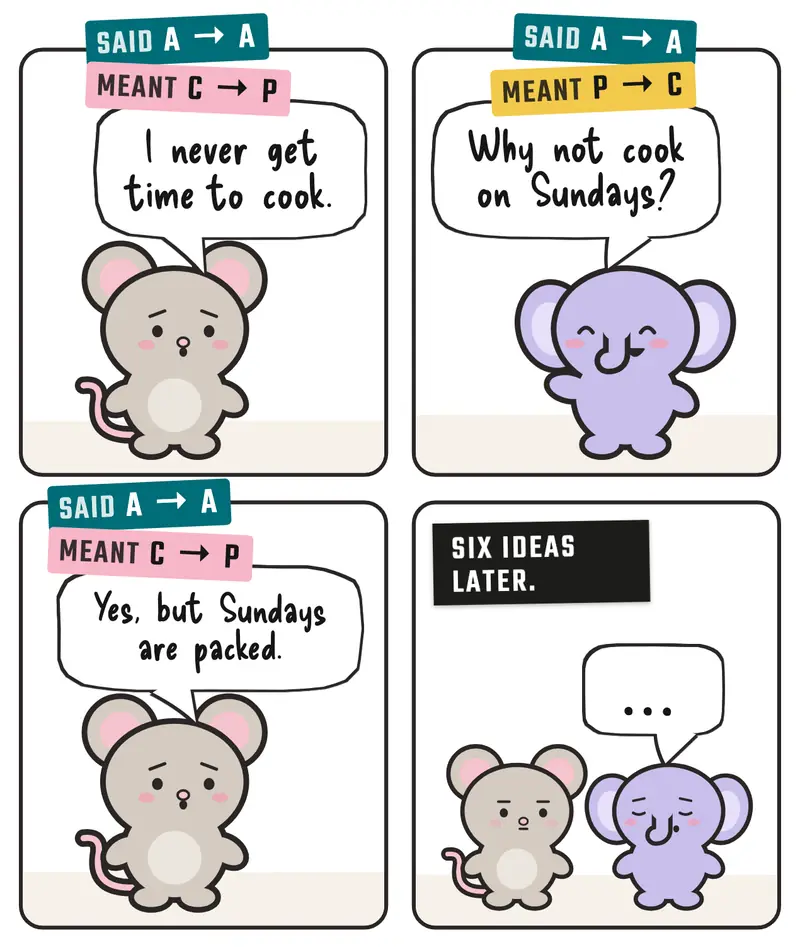
One person describes a problem. Others offer ideas, each starting "Why don't you...?", and each is met with "Yes, but...". Eventually everyone falls silent. The person with the problem gets confirmation that nobody can help them, and the helpers end up feeling useless.
Example: Priya tells her friends her flatmate never cleans. "Why don't you make a rota?" "Yes, but she ignores rotas." "Why don't you talk to her?" "Yes, but she gets defensive." "Why don't you move?" "Yes, but rents are crazy." Silence. "See, there's nothing I can do."
2. Kick Me
Berne said this game is played by people whose manner is like a sign reading "Please don't kick me". Other people hold back for a while, so the provocation escalates until someone finally obliges. Then comes the line, "Why does this always happen to me?"
Example: Rahul keeps missing deadlines after friendly warnings. When his manager finally gives him a formal warning, he feels singled out and tells his partner the manager has had it in for him from the start.
3. Ain't It Awful
A group bonds over how bad things are: the government, prices, young people, the in-laws. As a pastime it is harmless moaning. It becomes a game when someone has a stake in the misery and meets every offer of change with more proof of how awful it all is.
Example: Every family call becomes a list of what the neighbours did wrong this week. When a cousin suggests talking to them directly, the reply is a new grievance.
4. If It Weren't for You
One partner blames the other for holding them back. Berne's example was a wife who blamed her husband for restricting her social life, and who found, once the restriction was gone, that she was afraid of the very things he had "stopped" her doing. The complaint protects the person from a fear they haven't faced.
Example: "If it weren't for your family, I'd have started my own business years ago." When the family moves away, the business plan stays in a drawer.
5. See What You Made Me Do
Someone absorbed in a task gets interrupted, makes a slip, and turns on the person who interrupted: "See what you made me do." In Berne's account, the slip comes from the player's own irritation, and it gives them a reason to send the visitor away. Played as a way of life, it turns into handing all decisions to a partner and then blaming the partner when things go wrong.
Example: Ana lets her husband choose the holiday, the flat and the school, and then reminds him for years whenever any of them disappoints.
6. Now I've Got You, You SOB
One person waits for the other to make a mistake, then pounces with anger that has been stored up for a long time. Berne's example was a man who used a small, defensible complaint about a plumber's bill to vent far larger fury, and who realised afterwards how secretly pleased he had been by the provocation.
Example: Meena keeps a mental file of a colleague's small errors. When one finally reaches the client, she copies in the whole team and feels a rush of righteous relief.
7. Uproar
A quarrel escalates, often over something small, and ends with a slammed door. Berne listed it among the sexual games, because in his examples the fight kept closeness at bay, and he noted that any two people trying to avoid intimacy can play it.
Example: A couple who barely see each other all week pick a fight about the dishes every Sunday night and go to bed angry, which saves them from a harder conversation about how far apart they've drifted.
8. Wooden Leg
The thesis of this game, in Berne's words, is "What do you expect of a man with a wooden leg?" A limitation is used as the reason not to try what is still possible. The limitation is often real. The game lies in how it is used.
Example: "I'm an overthinker, I've always been like this," said each time a decision is due, so the decision never gets made.
9. Harried
Berne described the harried housewife, juggling ten or twelve roles until she is exhausted. Anyone can play it: the person who says yes to everything at work and at home until they collapse, at which point nobody can ask anything more of them.
Example: Kavya runs the household, cares for her mother-in-law and stays late at the office. She never asks for help, then gets so run down that she has to stop, and spends the week feeling both guilty and relieved.
10. I'm Only Trying to Help You
Berne put this one among the consulting room games, though it shows up wherever people help for a living, and at home too. A helper gives advice that keeps not working. The person being helped doesn't follow it, or follows it badly, and the helper ends up feeling unappreciated: "I'm only trying to help you." Karpman used it as his example of a game switch, with the Rescuer ending up as the Victim.
Example: An older brother keeps sending his sister job links she never applies for. Eventually he snaps, she tells him he's always lecturing her, and both feel wronged.
How to Step Out of a Game
You can't stop a game you can't see, so the first step is noticing your own part.
- Know your usual opening and your usual hook. Do you tend to invite, with a hard-luck story, or get hooked, by rushing in to fix things?
- Watch for the switch. The moment the conversation turns, and the familiar feeling arrives, is the best clue you have.
- Answer the surface message straight. If someone asks for advice and you sense a "Yes, but" coming, you can ask what kind of help they want, or simply listen.
- Ask directly for what you need. Many games are a roundabout way of getting recognition. Asking for it plainly, and giving it freely, takes away the reason to play.
- Try a different corner. Acey Choy's Winner's Triangle offers a healthier counterpart to each drama role (Choy, 1990). The guide to the drama triangle covers it in full.
None of this guarantees the other person will stop too. Changing your own move does take away the response they expect, and that is often enough to slow the game down.
How Therapy Works With Games
Berne worked out much of game analysis in therapy groups, where games tend to show up in the room itself. In TA therapy, individual or group, the work usually starts with a contract about what you want to change. Game work then looks at a few things: which games you play most, at what degree, where you learned them, and what you are hoping to get from them that you could ask for directly. Because a game needs two players, the relationship with the therapist is also a safe place to notice an invitation and try a different answer. The page on psychotherapy informed by Transactional Analysis describes what it involves.
Reflective Questions, Not a Quiz
There is no score here. Notice which questions you'd rather skip.
- Which conversation in your life ends the same way every time?
- Do you tend to open games, or get pulled into other people's?
- Which of the ten games above made you wince, and why?
- What is the familiar bad feeling you are left with afterwards?
- What would you be asking for if you asked for it directly?
- Who in your life doesn't take the bait, and what do they do instead?
If a pattern you recognise involves violence or threats, please don't treat it as something to work out alone. Speak to someone you trust, and use the emergency numbers above if you are in danger.
Frequently Asked Questions
What are games in transactional analysis?
A game in TA is a repeated series of exchanges with a hidden message underneath, ending in a switch and a familiar bad feeling for the people involved. Eric Berne defined a game as "an ongoing series of complementary ulterior transactions progressing to a well-defined, predictable outcome" and described dozens in Games People Play (1964).
What is the Yes But game?
"Why Don't You, Yes But" is the game in which someone asks for help and turns down every suggestion with "Yes, but...". It ends with the helpers feeling useless and the person with the problem confirmed in the belief that nobody can help. Berne said it was the pattern that first gave him the idea of games.
What is the Kick Me game?
In "Kick Me", a person behaves in ways that invite criticism or rejection, escalating until someone responds, and then feels picked on: "Why does this always happen to me?" It confirms an old belief that they will always be the one who gets kicked.
What is Formula G in transactional analysis?
Formula G is Berne's 1972 summary of how every game unfolds: Con + Gimmick = Response, then Switch, Cross-up and Payoff. The con hooks a weak spot in the other person, the exchange runs for a while, someone switches position, there is a moment of confusion, and both people collect a familiar bad feeling.
What are the three degrees of games?
Berne graded games by their harm. First-degree games are socially acceptable and easy to talk about. Second-degree games do no permanent harm but are hidden. Third-degree games are played for keeps and end in serious harm.
If you keep ending up in the same game with the same people, a free 15-minute intro call is a low-pressure place to start.
Sources
- Berne E. Games People Play: The Psychology of Human Relationships. Grove Press; 1964. Game descriptions checked against the Eric Berne estate's Games People Play pages.
- Berne E. What Do You Say After You Say Hello? The Psychology of Human Destiny. Grove Press; 1972.
- What is transactional analysis? International Transactional Analysis Association.
- Karpman SB. Fairy tales and script drama analysis. Transactional Analysis Bulletin. 1968;7(26):39-43.
- Choy A. The winner's triangle. Transactional Analysis Journal. 1990;20(1):40-46.
- Jusik P. Strokes, games and learning in groups. International Journal of Transactional Analysis Research & Practice. 2020;11(1):75-79.
- Bicehouse T, Hawker L. Degrees of games: an application to the understanding of domestic violence. Transactional Analysis Journal. 1993;23(4):195-200.
Related writings
9 min read
The Karpman Drama Triangle: Persecutor, Rescuer, Victim
Karpman's drama triangle in transactional analysis: the Persecutor, Rescuer and Victim roles, why people switch between them, and how the Winner's Triangle helps.
9 min read
Strokes in Transactional Analysis and the Stroke Economy
What strokes are in transactional analysis: positive, negative, conditional and unconditional, Steiner's five stroke economy rules, and how to get out of them.
12 min read
What Is Transactional Analysis? Ego States & TA Therapy
What is transactional analysis? A plain guide to Eric Berne's ego states (Parent, Adult, Child), transactions and life scripts, and what TA therapy is like.
Talk to a therapist about this
Transactional Analysis is the main way Dandelion works with individuals. Here is what it looks like in practice.
Transactional Analysis therapyYou can also look at online individual therapy.