
The Bystander Role in Transactional Analysis
By the Dandelion Reflect team
Last updated:
Petruska Clarkson's bystander role in transactional analysis: why people watch harm and stay out of it, what it costs, and how to step in without rescuing.
Goes further than TA 101, lesson 14: the drama triangle.
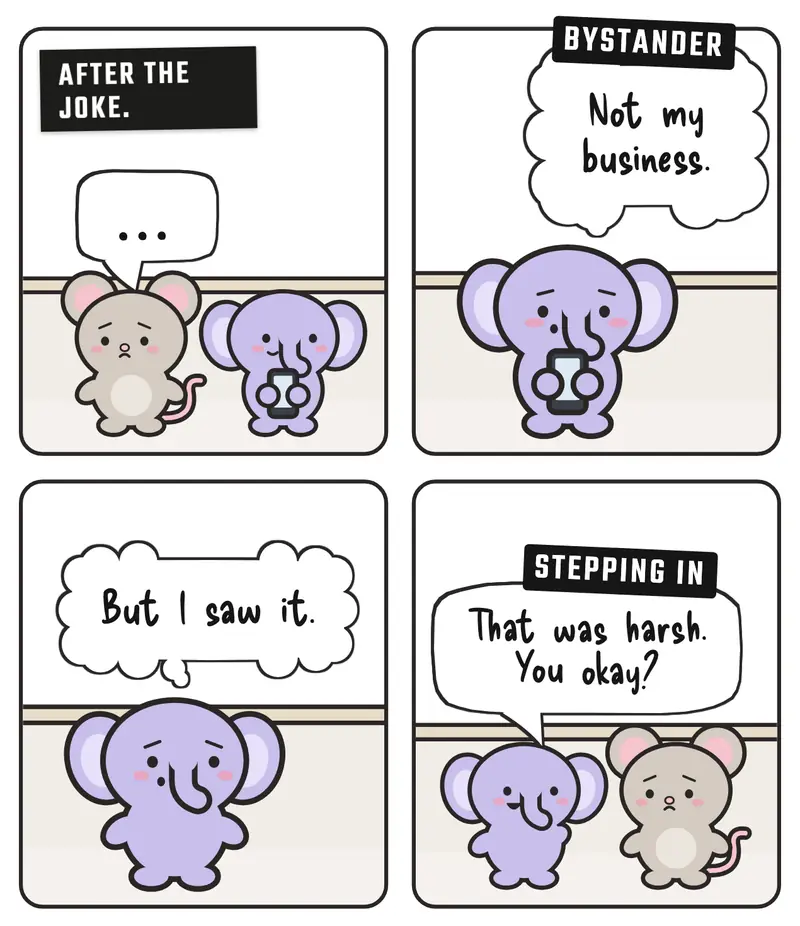
TL;DR: In transactional analysis (TA), the Bystander is the person who sees that something is wrong and doesn't get involved. Petruska Clarkson described the role in 1987 and in 1993 called it the fourth game role, alongside Karpman's Persecutor, Rescuer and Victim. She placed the drama in context: its history, and the consent of the people watching it. Social psychology has found something similar: people are less likely to help when others are present, though less so when the danger is obvious. Clarkson's alternative to bystanding is responsible involvement, which is different from rescuing.
At a cousin's wedding, an uncle makes a joke about her weight in front of the guests. A few people laugh. Someone looks at their phone. The cousin goes quiet, and the music carries on. Later, more than one person at that table thinks: I should have said something.
Lesson 14 of the free course maps the drama triangle: the Persecutor, Rescuer and Victim inside a conflict. This post is about everyone else in the room.
What Clarkson Meant by the Bystander
Petruska Clarkson, a TA writer and the author of Transactional Analysis Psychotherapy: An Integrated Approach (1992), published "The Bystander Role" in the Transactional Analysis Journal in 1987 (Clarkson, 1987). The paper looks at bystanding in ordinary life and in therapy. It describes a sequence of five critical choice points at which a person can step in, and it surveys the reasons people give for not doing so and what staying out costs them.
Her contribution to TA theory was to add the Bystander, or audience, to Karpman's triangle. In her framing, a drama happens against a background of history and with the consent of the people watching it. In 1993 she followed up with "Bystander Games", which analyses twelve bystander games in personal, organisational and national settings. That paper names the Bystander as the fourth game role in the drama triangle (Clarkson, 1993). She later wrote a book on the subject, The Bystander (1996). Its publisher describes a bystander as someone who "does not become involved when someone else needs help".
Clarkson wrote of intervening "responseably", a spelling that, as we read it, keeps the word "response" inside "responsibly". Her 1993 paper presents the alternative to bystanding as responsible involvement, intimacy and autonomy.
Why the Audience Matters
The three roles in Karpman's triangle need each other. One way to read Clarkson's addition is that they also need room to play, and the people around them help decide how much room there is.
- In a family, a parent belittles one child at every meal while the other adults at the table say nothing. The silence can tell everyone, including the child, that this is normal. (Children watching at home are not bystanders by choice.)
- At work, a manager mocks a junior colleague's work in a meeting. Nobody objects, and the manager may learn that it is acceptable here.
- In a group chat, someone forwards a cruel joke about a relative. A few people send a laughing emoji, and most send nothing. Both tell the sender something.
In each case the people watching aren't doing the harm. They still shape what happens next, because a drama that meets no response can keep going.
What Social Psychology Found
Clarkson wasn't the first to look at bystanders. In a well-known 1968 experiment, John Darley and Bibb Latané had participants overhear what seemed to be someone having a seizure. Participants who believed others could also hear it felt less personally responsible and were slower to report it. Personality and background measures didn't predict who helped. The authors suggested that bystanders fail to act less from indifference than from how they respond to the other people present (Darley & Latané, 1968).
A 2011 meta-analysis pulled together the research from the 1960s to 2010: more than 7,700 participants and 105 effect sizes. It confirmed that the presence of others makes an individual less likely to help, on average. The effect was weaker when the situation was clearly dangerous, when a perpetrator was present, and when the other bystanders were not strangers (Fischer et al., 2011).
These studies looked at emergencies, not everyday put-downs, so applying them here is our step, not theirs. With that caveat, two points stand out. Bystanding seems to depend more on the situation than on personality, so anyone can find themselves in it. And knowing the people around you seems to make stepping in easier, which is a reason to talk about it at home and at work.
Why People Stay Out
Clarkson surveyed the motivations and rationalisations people give for bystanding. The lines below are our own examples of the kind of thing people tell themselves:
- "It's a family matter. It's not my place."
- "I don't know the full story."
- "Someone else will say something."
- "If I speak up, I'll only make it worse."
- "They're adults. They can sort it out."
Some of these are sometimes true. That is why they work so well as reasons to stay quiet. In TA terms, the useful question is whether you thought it through in the moment, or whether an old rule decided for you. Many people learned as children that staying out of other people's arguments was the safest place to be, and in their families it may well have been.
The Cost of Standing By
Clarkson's 1987 paper looks at the psychological costs of bystanding, and at guilt and responsibility. The costs below are our own examples, not her list. The person being hurt may feel all the more alone for being watched in silence. The bystander may carry a quiet guilt, or start to see themselves as someone who doesn't act. And the pattern can carry on when nothing in it is interrupted.
None of this means you were to blame for someone else's behaviour. The person doing harm is responsible for it. The bystander's question is a smaller one: what, if anything, is mine to do?
Bystander, Rescuer or Responsibly Involved?
Stepping out of the Bystander role doesn't mean jumping into the Rescuer's corner. The difference is in what you take on.
| Bystander | Rescuer | Responsibly involved | |
|---|---|---|---|
| What you do | See it and stay out | Step in and take over | Step in with your own part, and ask what the other person wants |
| What it can feel like to the person hurt | You're on your own | You can't handle this | I saw it, and I'm here if you want me |
| Who ends up deciding what happens next | Often the person doing harm | You | The person hurt, with support |
The Karpman post describes a similar stance in Choy's winner's triangle. As we read it, Clarkson's responsible involvement is the bystander's version of that stance.
Not stepping in can also be a sound choice: if it would put you or someone else in danger, or if the person has asked you not to, unless a child is at risk or someone is in immediate danger. Choosing that with your eyes open is different from looking away because an old rule told you to.
When It's Abuse or an Emergency
Everyday drama is different from abuse or danger. If someone is being hit, threatened or controlled, or you think someone is at risk right now, getting help comes first. In India, call 112 in an emergency. Tele-MANAS (14416 or 1-800-891-4416) is the government's free tele-mental health line and runs 24x7. Outside India, contact your local emergency number.
Small Ways to Step In
For everyday put-downs, getting involved rarely needs a speech. Some options, from smallest to largest:
- Don't join in. Don't laugh, don't forward, don't add to the pile.
- Name it, briefly. "That sounded harsh." "Hey, that's not fair on her."
- Check in afterwards. "Are you okay? What would help, if anything?"
- Change the room. Ask the person to help you with something in the kitchen, or move the meeting on.
- Bring in help. Talk to HR, a teacher, a counsellor or another family member, or report what you saw.
Checking with the person before you do more leaves the decision with them.
How Therapy Works With Bystanding
In therapy, bystanding can come up from both sides. Some people come in carrying years of watching something at home that they couldn't stop as children. Others notice that they freeze whenever conflict starts near them, and want to understand why. Freezing is a protective reaction, not a character flaw.
TA work often starts with a contract about what you want to be able to do: say one sentence in the moment, for example, or check in with someone afterwards. From there it can look at the family rules about conflict you grew up with and the injunctions underneath them, and at what you feared would happen if you spoke. The guide to psychological games can help you see the larger pattern you've been watching.
Reflective Questions, Not a Quiz
There is no score here. Notice which questions you'd rather skip.
- When conflict starts near you, do you lean in, freeze or leave?
- What did you learn as a child about getting involved in other people's arguments?
- Is there a moment you still think about, when you wish you had said something?
- Who in your life would you want to step in for you? Who do you step in for?
- What is the smallest thing you could do next time?
If one of these brings up something heavy, that is worth taking to a therapist instead of working through it alone.
Frequently Asked Questions
What is the bystander role in transactional analysis?
The Bystander is the person who sees that something harmful is happening and doesn't get involved. Petruska Clarkson described the role in 1987 and in 1993 called it the fourth game role in the drama triangle. She placed the drama in context: its history, and the consent of those watching.
Is the Bystander part of the drama triangle?
Karpman's original 1968 triangle has three roles: Persecutor, Rescuer and Victim. Clarkson proposed the Bystander as a fourth game role, the audience around the triangle, in her papers of 1987 and 1993.
What is the bystander effect?
It is social psychology's finding that people are less likely to help when others are present. Darley and Latané showed it in 1968, and a 2011 meta-analysis of more than 100 effect sizes confirmed it, while finding it weaker in clearly dangerous situations.
What is the difference between a bystander and a Rescuer?
A bystander stays out. A Rescuer steps in and takes over, often without being asked, in a way that leaves the other person less able to act. Responsible involvement is a third option, outside the game: you do your own part and ask the person what they want.
How do I stop being a bystander?
Start small. Decline to join in, name what you saw in one sentence, or check in with the person afterwards and ask what would help. In an emergency, call for help first.
If you often freeze when conflict starts near you, a free 15-minute intro call is a low-pressure way to talk it through. The page on Transactional Analysis therapy describes what TA therapy involves.
Sources
- Clarkson P. The bystander role. Transactional Analysis Journal. 1987;17(3):82-87.
- Clarkson P. Bystander games. Transactional Analysis Journal. 1993;23(3):158-172.
- Clarkson P. Transactional Analysis Psychotherapy: An Integrated Approach. Tavistock/Routledge; 1992.
- Clarkson P. The Bystander. Wiley; 1996. ISBN 978-1-897635-89-6.
- Karpman SB. Fairy tales and script drama analysis. Transactional Analysis Bulletin. 1968;7(26):39-43.
- Darley JM, Latané B. Bystander intervention in emergencies: diffusion of responsibility. Journal of Personality and Social Psychology. 1968;8(4):377-383.
- Fischer P, Krueger JI, Greitemeyer T, et al. The bystander-effect: a meta-analytic review on bystander intervention in dangerous and non-dangerous emergencies. Psychological Bulletin. 2011;137(4):517-537.
Related writings
12 min read
Psychological Games in Transactional Analysis: 10 Examples
Psychological games in transactional analysis: Berne's definition, Formula G, the three degrees of games and 10 games people play, with examples and ways out.
9 min read
The Karpman Drama Triangle: Persecutor, Rescuer, Victim
Karpman's drama triangle in transactional analysis: the Persecutor, Rescuer and Victim roles, why people switch between them, and how the Winner's Triangle helps.
6 min read
12 Transactional Analysis Injunctions, With Examples
The 12 transactional analysis injunctions Bob and Mary Goulding described, from Don't Exist to Don't Feel: how each sounds, where it starts, how therapy helps.
Talk to a therapist about this
Transactional Analysis is the main way Dandelion works with individuals. Here is what it looks like in practice.
Transactional Analysis therapyYou can also look at online individual therapy.