
Ego States in Transactional Analysis: Parent, Adult, Child
By the Dandelion Reflect team
Last updated:
Ego states in transactional analysis: Berne's Parent, Adult and Child, structural vs functional models, the five functional modes, contamination and examples.
TL;DR: An ego state, in transactional analysis (TA), is a consistent pattern of thinking, feeling and behaving that you can see in what a person says and does. Eric Berne described three: the Parent, copied from parents and other figures; the Adult, which responds to the here and now; and the Child, replayed from your own childhood. TA looks at them in two ways. The structural model asks what each ego state holds and where it came from. The functional model sorts behaviour into five modes: Controlling Parent, Nurturing Parent, Adult, Adapted Child and Free Child. TA also describes contamination and exclusion, and you can learn to spot ego states with practice.
Ego states are the core of transactional analysis. At any moment you are thinking, feeling and acting in a way that belongs to one of three states: Parent, Adult or Child. You might hear your mother's exact tone come out of your mouth, calmly sort out a booking that went wrong, and then feel about seven years old when your manager frowns, all before lunch. If TA is new to you, start with what transactional analysis is. This guide goes deeper: Berne's definition, the structural and functional models and why they shouldn't be mixed, the five functional ego states, the Little Professor, contamination and exclusion, and practice examples with answers.
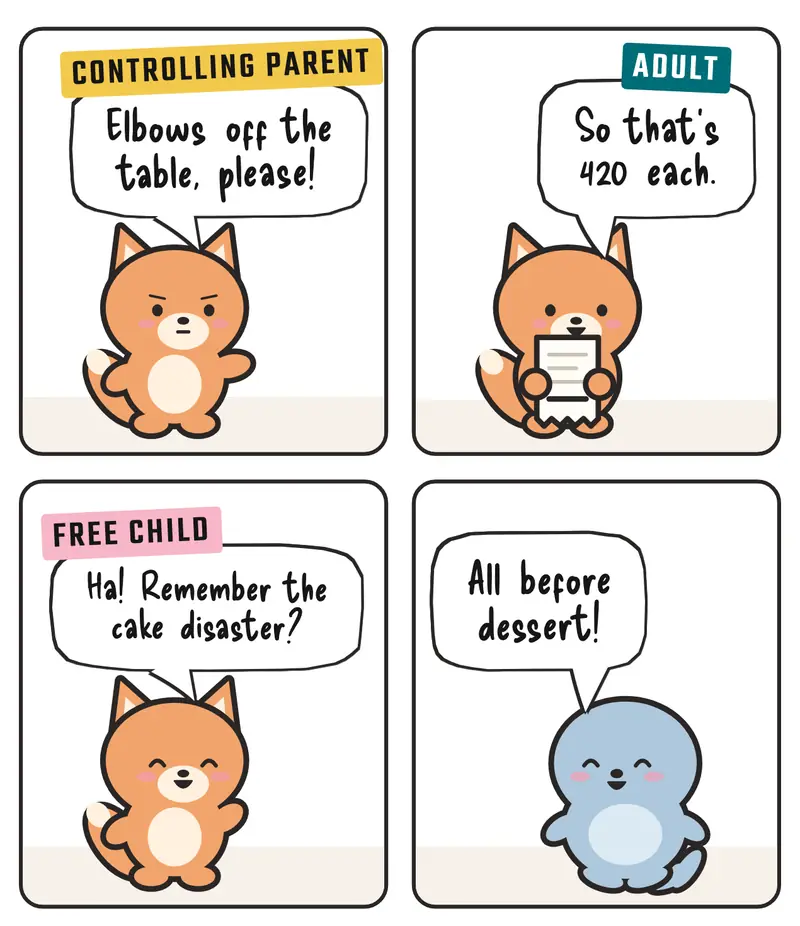
What Is an Ego State?
Berne defined an ego state as "a consistent pattern of feeling and experience directly related to a corresponding consistent pattern of behavior" (Berne, 1966, quoted on the Eric Berne estate's site). The International Transactional Analysis Association (ITAA) puts it more simply: "Each ego state is an entire system of thoughts, feelings, and behaviors from which we interact with one another" (ITAA). Berne set out the model in Transactional Analysis in Psychotherapy (1961).
Berne trained as a psychoanalyst, but ego states are not Freud's superego, ego and id. The point of an ego state is that it can be observed. Berne suggested four ways of identifying one (Berne, 1961):
- Behavioural: words, tone of voice, gestures, posture and facial expression.
- Social: the ego state other people tend to respond from, which usually complements yours. Parent behaviour, for example, often draws a Child response.
- Historical: where the pattern came from, such as a parent who spoke exactly like this.
- Phenomenological: re-experiencing the past vividly, as if it were happening again.
The more of these that agree, the more confident you can be.
You may also see ego states described as "recordings" in the brain, with the Parent made of what a child took in during roughly the first five years. That image comes from Thomas Harris's bestseller I'm OK, You're OK (1967), which popularised TA. It is not Berne's definition.
The Three Ego States: Parent, Adult and Child
Parent. Thoughts, feelings and behaviour copied from parents and other parent figures, such as grandparents, teachers or an older sibling. You tell a grown-up friend to take a jumper because it's cold, in your mother's exact tone. That is Parent.
Adult. Responses to what is actually happening now, using everything you know and can do as a grown-up. Your train is cancelled, and you check the alternatives, rebook and message the people waiting for you. That is Adult. Being in Adult doesn't mean having no feelings. It means your response fits the present situation.
Child. Thoughts, feelings and behaviour replayed from your own childhood. A senior colleague says "can I have a word?" and your stomach drops the way it did outside the head teacher's office. Or you see the sea and run toward it laughing. Both are Child.
None of the three is good or bad. Everyone uses all three, and healthy functioning means being able to move between them as the situation needs.
Structural and Functional Models: Two Ways to Look at Ego States
This is where many readers, and plenty of exam answers, get confused. TA uses two models, and they answer different questions (Stewart & Joines, TA Today, Lifespace, 2012).
- The structural model is about content. It asks what is stored in each ego state and where it came from: which parent's rules are in your Parent, which childhood experiences are in your Child.
- The functional model is about process. It asks how you are using an ego state right now, in observable behaviour: are you controlling or nurturing, adapting or spontaneous?
Mixing them up causes trouble. "Critical Parent" is a functional term. It describes a way of behaving, and there is no compartment inside you called the Critical Parent. TA writers have argued about how best to relate the two models for decades. Rebecca Trautmann and Richard Erskine compared the different views in 1981 (Trautmann & Erskine, 1981), and a group of senior TA authors set out their differing definitions side by side in 1988 (Erskine et al., 1988).
The Five Functional Ego States
In the functional model, the Parent and the Child are each split in two, and the Adult stays whole. That gives five modes of behaviour.
Many TA writers describe a positive and a negative side to each mode except the Adult (Stewart & Joines, 2012).
Controlling (Critical) Parent
Sets limits, gives rules and tells people what to do. On the positive side: "Hold my hand while we cross the road." On the negative side, it puts people down: "You never get anything right." "Critical Parent" and "Controlling Parent" are used for the same mode, and searchers use both.
Nurturing Parent
Cares for, comforts and looks after others. On the positive side: "You look exhausted. Sit down, I'll make tea." On the negative side, it smothers: doing for someone what they could do for themselves, or helping when no help was asked for.
Adult
Takes in information, weighs it and responds to the present. "The report is missing last quarter's figures. Can you add them by Friday?" The functional model doesn't split the Adult.
Adapted Child
The part that learned to fit in with what grown-ups expected. On the positive side, it gives us manners and the ability to cooperate. On the negative side, it complies against our own interests, or rebels. Rebellion still counts as Adapted Child, because it is shaped by reacting to the rules, not by what the person wants.
Free Child
Also called the Natural Child. Spontaneous feeling, play, curiosity and delight: laughing at a joke, dancing at a wedding, getting lost in a hobby. On the negative side, it can act on impulse with no thought for anyone else.
John Dusay turned the five modes into the egogram, a bar chart of how much energy a person seems to put into each (Dusay, 1972). Susannah Temple later proposed "functional fluency" as a name for how the integrating Adult shows up in behaviour, and described a way to teach it that suits educators (Temple, 1999).
Second-Order Structure and the Little Professor
Berne's structural model can be drawn in more detail, called second-order structure.
- Inside the Parent are the Parent, Adult and Child of each parent figure you took in. You absorbed your father's rules, and also his way of reasoning and his feelings.
- Inside the Child are three earlier parts. One is the body-based Child of a baby's first needs and sensations. Another is the Little Professor, the Adult inside the Child: the curious, intuitive, inventive thinking of a young child. The third is an early, magical version of the Parent, which Berne called the Electrode (Berne, 1972, cited in English, 1988).
The Little Professor matters for script theory, because it is the part that makes a child's early decisions about how to survive. Those decisions add up to the life script. The idea has also puzzled theorists: Ian Stewart wrote about "the strange case of the Little Professor" in 2001 (Stewart, 2001).
Contamination and Exclusion
Berne described two ways ego states can stop working well together (Berne, 1961).
Contamination happens when content from the Parent or the Child is mistaken for Adult fact.
- Parent contamination is a prejudice taken as truth: "People from that background can't be trusted." "Real men don't ask for help."
- Child contamination is an old fear or fantasy taken as truth: "If I speak up, everyone will turn on me." "If I make one mistake, I'll lose everything."
- Double contamination is both at once.
Untangling it is called decontamination: the Adult checks the belief against present-day evidence and notices where it really came from.
Exclusion happens when one or two ego states are shut out. Someone in constant Parent runs everything on rules and duty. Someone in constant Adult is reliable and reasonable but rarely plays or shows feeling. Someone who excludes the Adult is pushed around by old rules and old feelings with little here-and-now checking.
Most people show a little of both at times, especially under stress. These are everyday patterns, and none of them is a diagnosis.
Spot the Ego State: Practice Examples With Answers
Exam questions often ask which ego state a line comes from. Words on a page are only part of Berne's behavioural clue, so in real life tone, gesture and context matter as much. With that caveat, here are seven to try. Cover the answers and decide first.
- A manager reading a report: "This section is missing last quarter's figures. Can you add them by Friday?"
- A parent, wagging a finger: "How many times have I told you? You never listen."
- A friend: "You've had a long day. Let me make you some tea."
- A colleague, seeing the first snow: "Snow! Come outside, quick!"
- After a small mistake, head down: "Sorry, sorry, I'll redo it. I'm so stupid."
- A teenager, rolling their eyes: "Whatever. I'll do what I want."
- A mentor to a trainee: "Before you decide, what do the data actually show?"
Answers.
- Adult. A factual request about the present, in a neutral tone.
- Controlling (Critical) Parent, negative side. A put-down, with "never" and a pointing finger.
- Nurturing Parent, positive side. Care that responds to a real need.
- Free Child. Spontaneous delight.
- Adapted Child, compliant. Apologising and putting yourself down to placate an imagined critic. The put-down echoes an internal Parent, but the behaviour on show is Adapted Child.
- Adapted Child, rebellious. It looks free, but it is a reaction against the rules, which makes it Adapted, not Free.
- Adult. The mentor invites the trainee to check the facts, without telling them what to conclude. Said with a sigh and a raised eyebrow, the same words could come from the Controlling Parent.
How Therapy Works With Ego States
In TA therapy, ego states become a shared language. After agreeing a contract about what you want to change, you and the therapist might notice the moment you slip into Adapted Child with someone senior, or hear a parent's voice in your own self-criticism. The work often includes decontamination, checking old beliefs against present reality; strengthening the Adult so it can step in sooner; and giving the Free Child room again.
Ego states also make sense of what happens between people. Every exchange is a transaction from one ego state to another, and psychological games run on ulterior transactions, where the hidden message comes from a different ego state from the spoken one. Much of what people call inner child work happens in the Child ego state, and an honest guide to inner child work explains what it can and can't do. The page on Transactional Analysis therapy describes what TA therapy involves.
Reflective Questions, Not a Quiz
There is no score here. Notice which questions you'd rather skip.
- Whose voice do you hear when you criticise yourself?
- When did you last feel much younger than your age? Who were you with?
- Which of the five functional modes do you use most? Which least?
- When you're stressed, do you get more controlling, more caretaking, more compliant or more rebellious?
- When did your Free Child last get some time?
- Is there a belief you hold as fact that might be a Parent rule or a Child fear?
If one of these brings up something heavy, please don't carry it alone. In India, Tele-MANAS (14416 or 1-800-891-4416) is the government's free tele-mental health line and runs 24x7. Outside India, contact your local emergency number or crisis line.
Frequently Asked Questions
What are the five functional ego states?
The functional model sorts behaviour by the ego state it comes from, which gives five modes: Controlling (or Critical) Parent, Nurturing Parent, Adult, Adapted Child and Free (or Natural) Child. The Parent and Child modes each have a positive and a negative side, so Nurturing Parent can comfort or smother. The model describes what someone is doing right now. What is stored in each ego state is the job of Berne's structural model of Parent, Adult and Child.
What is the critical parent ego state?
The Critical Parent, also called the Controlling Parent, is the functional mode in which a person sets rules, gives orders or criticises. Its positive side sets useful limits, such as keeping a child safe. Its negative side puts people down. It describes behaviour, not a separate part stored inside you.
What is the difference between the structural and functional model of ego states?
The structural model is about content: what is stored in each ego state and where it came from. The functional model is about process: how a person is using their ego states right now, sorted into Controlling Parent, Nurturing Parent, Adult, Adapted Child and Free Child. TA writers warn against mixing the two.
What is the Little Professor in transactional analysis?
The Little Professor is the Adult inside the Child ego state: the curious, intuitive, inventive thinking of a young child. In TA it is the part that makes the early decisions that shape the life script.
What is contamination in transactional analysis?
Contamination is when Parent or Child content is mistaken for Adult fact. A prejudice taken as truth is Parent contamination, and an old childhood fear taken as truth is Child contamination. Decontamination means checking those beliefs against present-day evidence.
How do you identify which ego state someone is in?
Berne suggested four clues: behaviour (words, tone, gesture and expression), how other people respond, where the pattern came from in the person's history, and the person's own sense of re-living the past. The more clues agree, the surer the answer. Words alone, as in exam questions, give only part of the picture.
If you'd like to understand your own ego-state patterns with a TA therapist, a free 15-minute intro call is a low-pressure place to start.
Sources
- Berne E. Transactional Analysis in Psychotherapy. Grove Press; 1961.
- Berne E. Principles of Group Treatment. Oxford University Press; 1966. Ego-state definition as quoted on the Eric Berne estate's site.
- Berne E. What Do You Say After You Say Hello? The Psychology of Human Destiny. Grove Press; 1972.
- What is transactional analysis? International Transactional Analysis Association.
- Harris TA. I'm OK, You're OK. Harper & Row; 1967.
- Trautmann RL, Erskine RG. Ego state analysis: a comparative view. Transactional Analysis Journal. 1981;11(2):178-185.
- Erskine RG, Clarkson P, Goulding RL, Groder MG, Moiso C. Ego state theory: definitions, descriptions, and points of view. Transactional Analysis Journal. 1988;18(1):6-14.
- Dusay JM. Egograms and the "constancy hypothesis". Transactional Analysis Journal. 1972;2(3):37-41.
- Temple S. Functional fluency for educational transactional analysts. Transactional Analysis Journal. 1999;29(3):164-174.
- Stewart I. Ego states and the theory of theory: the strange case of the Little Professor. Transactional Analysis Journal. 2001;31(2):133-147.
- English F. Whither scripts? Transactional Analysis Journal. 1988;18(4):294-303.
- Stewart I, Joines V. TA Today: A New Introduction to Transactional Analysis. 2nd ed. Lifespace; 2012.
Related writings
12 min read
Psychological Games in Transactional Analysis: 10 Examples
Psychological games in transactional analysis: Berne's definition, Formula G, the three degrees of games and 10 games people play, with examples and ways out.
11 min read
Life Scripts in Transactional Analysis and the Script Matrix
What a life script is in transactional analysis: Berne's idea, Steiner's script matrix, winning and losing scripts, the six script types and how scripts change.
13 min read
Inner Child Work: An Honest Guide (Not the Instagram One)
What inner child work actually is in Transactional Analysis terms — early decisions, careful reparenting, what sessions look like, and when not to rush it.
Talk to a therapist about this
Transactional Analysis is the main way Dandelion works with individuals. Here is what it looks like in practice.
Transactional Analysis therapyYou can also look at online individual therapy.