
3 Types of Transactions in Transactional Analysis
By the Dandelion Reflect team
Last updated:
The 3 types of transactions in transactional analysis (complementary, crossed, ulterior), with diagrams, examples and Berne's rules of communication.
TL;DR: A transaction, in transactional analysis (TA), is one stimulus from one person and one response from another, each sent from an ego state: Parent, Adult or Child. Eric Berne described three types. In a complementary transaction the reply comes back from the ego state that was spoken to, so the talk can keep going. In a crossed transaction the reply comes from a different ego state, and the conversation stalls. In an ulterior transaction a hidden message travels under the spoken one, and the hidden message decides what happens next. Berne turned these into three rules of communication, and Stephen Karpman showed how crossing a transaction on purpose can get you out of a stuck exchange.
Some conversations flow and some stop dead after one line. Transactional analysis explains the difference by looking at the smallest unit of talk, one remark and its reply, and asking which part of each person sent it. This guide covers what a transaction is, how TA draws one, the three types with everyday examples, Berne's three rules of communication, Karpman's "options" for getting unstuck, and a short practice set with answers. If TA is new to you, start with what transactional analysis is, and if Parent, Adult and Child are new, read the guide to ego states first.
What Is a Transaction?
Berne put it simply: "The unit of social intercourse is called a transaction" (Berne, 1964, quoted on the Eric Berne estate's site). When two people meet, sooner or later one of them says or does something that acknowledges the other. That is the transactional stimulus. The other person then says or does something in reply. That is the transactional response. The reply usually becomes the next stimulus, so a conversation is a chain of transactions.
Every transaction is also an exchange of strokes, the units of recognition TA says people need. A nod in reply to a "good morning" counts as a transaction, and so does a sigh in reply to "did you pay the electricity bill?"
TA's question about each transaction is which ego state sent the stimulus, which ego state it was aimed at, and which ego state answered.
How to Draw a Transaction
TA draws each person as a stack of three circles: Parent at the top, Adult in the middle, Child at the bottom. An arrow, which Berne called a vector, runs from the ego state that sends the message to the ego state it is aimed at. A second arrow shows the reply.
Drawing an exchange this way slows it down. You can see, for example, that a question you meant as Adult to Adult landed as a Parent telling off a Child. The three types of transactions are three shapes these arrows can make.
Complementary Transactions
In a complementary transaction, the response comes from the ego state that was addressed and goes back to the ego state that sent the stimulus. On the diagram the arrows run parallel. Berne wrote that communication "will proceed smoothly as long as transactions are complementary" (Berne, 1964).
Three examples:
- Adult to Adult. "Is the 8:15 running today?" "Yes, it's on platform 3." A question about facts gets an answer about facts.
- Parent to Child, Child to Parent. "You look worn out. Sit down, I'll heat up dinner." "Thank you. I'm completely done in." Nurturing Parent offers care and the Child accepts it.
- Child to Child. "Shall we skip the queue and get momos instead?" "Yes! Let me grab my jacket." Two Free Child states agree to have fun.
Complementary doesn't mean healthy. A Controlling Parent telling someone off, answered by an apologetic Adapted Child, is also complementary. It can run for years in exactly the same shape: "You never think ahead." "Sorry, I know, I'm hopeless." The arrows are parallel, so nothing interrupts the pattern.
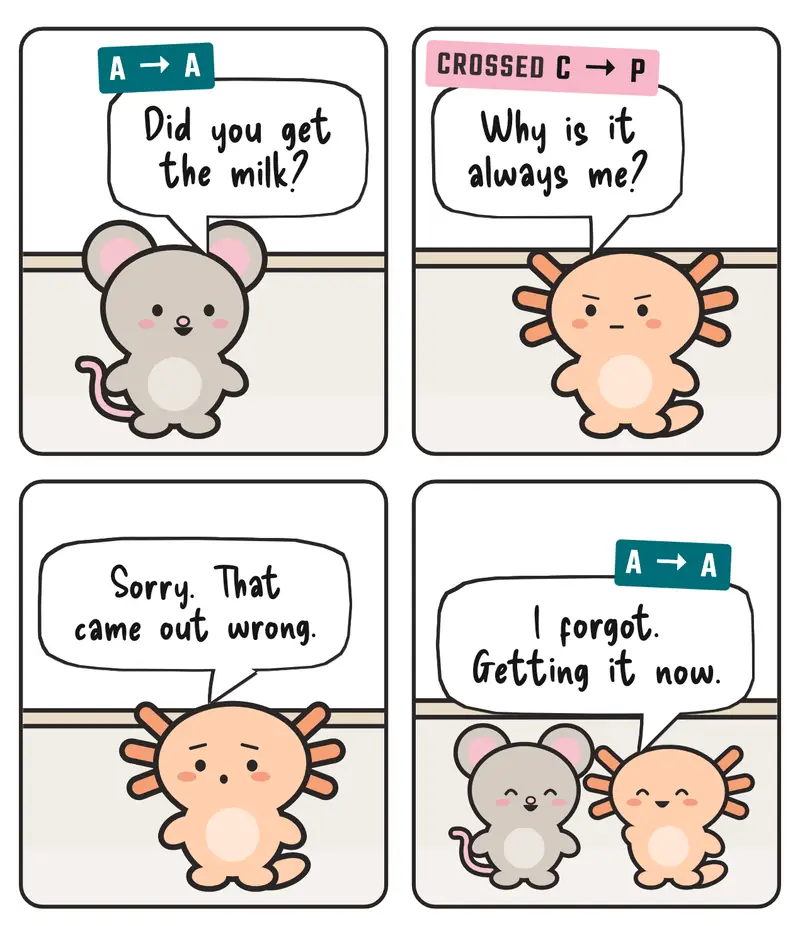
Crossed Transactions
In a crossed transaction, the response comes from a different ego state from the one that was addressed, or it is aimed back at a different ego state from the one that sent the stimulus. On the diagram the arrows cross. Berne's rule here is that "communication is broken off when a crossed transaction occurs" (Berne, 1964). The topic usually changes, at least for a while, to what just happened between the two of you.
Berne described two common forms. In Type I, an Adult question gets a Child reply aimed at the asker's Parent, as if the asker had been scolding. In Type II, an Adult question gets a Parent reply aimed at the asker's Child, talking down to them. Berne linked Type I to transference and Type II to countertransference (Berne, 1964).
Three examples:
- Type I. "Do you know when the plumber's coming?" "Oh, so now I'm meant to remember everything as well?" The question was about a time. The answer heard a criticism and replied to it.
- Type II. "What time does the meeting start?" "If you read your emails, you'd know." A plain question gets a put-down.
- A cross that helps. "You never get anything in on time!" "The report is due Friday. What do you need from me by Wednesday?" A Parent-to-Child stimulus gets an Adult reply. The telling-off can't continue in the same shape, and the talk moves to something workable.
A crossed transaction breaks the flow, which helps when the flow itself is the problem.
Ulterior Transactions
An ulterior transaction carries two messages at once. The social level is what the words say, often Adult to Adult. The psychological level is the hidden message, carried by tone, timing, a look or the choice of words, and it often comes from Parent or Child. On a diagram the social level is a solid arrow and the psychological level is a dashed one.
Berne described two kinds (Berne, 1964):
Angular transactions involve three ego states. One person's Adult speaks to the other's Adult on the surface, and at the same time aims a hidden message at the other's Child. Berne's example was a salesperson. A modern version: a shop assistant says, "This is our top model. It might be more than you were planning to spend." On the surface that is a fact about price. Underneath it is a dare to the customer's Child, who answers, "I'll take it."
Duplex transactions involve four ego states, two on each side. Both people talk Adult to Adult while their Child states have a second conversation. Two colleagues at 6 pm: "Are you staying late to finish the deck?" "Depends. Are you?" On the surface that is about work. Underneath it is an invitation, and both of them know it.
Ulterior messages aren't always carried by tone or body language. Attila Vandra, a TA writer, has described ways they travel through words and actions too (Vandra, 2009). Psychological games are built from ulterior transactions, and in TA practice, naming the hidden message openly is one way to step out of a game early.
Berne's Three Rules of Communication
Berne drew three rules from these patterns. He stated the first two in Games People Play (1964), and the third, about ulterior transactions, appears in Principles of Group Treatment (1966).
- As long as the vectors are parallel, communication can proceed indefinitely. Complementary transactions keep a conversation going, whether it is pleasant or not.
- If the vectors are crossed, communication is broken off. To get talking again, one or both people have to shift ego states.
- The behavioural outcome of an ulterior transaction is determined at the psychological and not at the social level (Berne, 1966). Whatever the words say, the hidden message decides what happens next.
The third rule is the one people recognise from their own lives. A partner says "fine, do what you want" in a flat voice, and both of you know the evening is not fine.
Options: Crossing a Transaction on Purpose
In 1971 Stephen Karpman, the psychiatrist who created the drama triangle, published "Options" in the first issue of the Transactional Analysis Journal (Karpman, 1971). He wrote about people stuck in "locked" transactions, complementary exchanges that repeat no matter what they try. His opening example was a man who was always explaining himself to someone who was always complaining. The complaints came from Parent ("You're bad") and the explanations came from Child ("I'm not"). Every new explanation was another Child reply, so the pattern held.
Karpman's answer was to cross the transaction deliberately, using an ego state the other person isn't expecting. For it to work, he listed four conditions:
- One or both ego states must actually change.
- The transaction must be crossed.
- The subject must change.
- The previous topic will be forgotten.
He stressed that this is a choice the Adult makes, not role-playing. The Adult picks which ego state to answer from and which ego state to aim at. Drawing five ego states on each side (Prejudiced Parent, Nurturing Parent, Adult, Free Child and Adapted Child), Karpman counted twenty-four possible ways of crossing a locked transaction (Karpman, 1971).
An example of how that can sound. A relative says, every visit, "You've put on weight again." The usual reply, "I've been so busy, I'll start walking," is Adapted Child, and the conversation repeats. Some options:
- Adult: "I'm happy with how I'm doing. How was the drive?"
- Free Child: "More of me to love!" said with a grin.
- Nurturing Parent: "You worry about all of us, don't you?"
Any of them could work. What helps is having more than one reply ready.
Transactions in Couples and Families
Many arguments at home are crossed transactions followed by a fight about the crossing. One partner asks a practical question from Adult, the other hears Parent and answers from Child, and within two lines the subject is fairness, not the question. TA's suggestion is to notice the cross early and go back to the question, Adult to Adult. The guide to couples communication covers this pattern in relationships, and the post on when a husband won't talk looks at what silence can mean as a reply.
Families also run on ulterior transactions that everyone has learned to read. "Have you eaten?" can be care, a check-up or a complaint about the last visit, and the person asked usually knows which.
Practice: Name the Transaction
Words on a page are only half the clue, because tone and context carry a lot. With that caveat, decide the type before you read the answers.
- "Can you pass the salt?" "Here you go."
- "Have you finished the slides?" "Stop micromanaging me!"
- Late at night, two flatmates eye a sink full of dishes. "Long day tomorrow?" "Very. I need an early night."
- A letting agent says, "This is the nicest flat on our list. It may be a bit above your budget." "We'll take it."
- "Let's go and see the sea!" "Race you!"
- "You've left the lights on again." "Sorry, sorry, I'm useless."
Answers.
- Complementary, Adult to Adult.
- Crossed, Type I. An Adult question gets a Child reply aimed at an imagined critical Parent.
- Ulterior (duplex). On the surface, Adult to Adult about schedules. Underneath, Child to Child: "Not me." The dishes will still be there in the morning, because the hidden message decides the outcome.
- Ulterior (angular). The agent's Adult states a fact about price while the hidden message dares the renter's Child.
- Complementary, Child to Child.
- Complementary, Parent to Child and back. A criticism gets the apology it invites. It is the shape of a locked transaction.
How Therapy Works With Transactions
In TA therapy, analysing transactions is one of the main methods. After you and the therapist agree a contract about what you want to change, you might slow down a recent argument, draw it, and find the line where it crossed. The sessions themselves are transactions too, so the way you and the therapist talk can show the same pattern as it happens, which gives you a safe place to try a different reply.
Over time the aim is to notice the cross while it is happening and choose an option instead of a reflex. The page on Transactional Analysis therapy describes what TA therapy involves.
Reflective Questions, Not a Quiz
There is no score here.
- Think of a conversation that went wrong this week. Where did it cross?
- Who in your life do you have a "locked" transaction with? What is your usual reply?
- When someone asks you a plain question, how often do you hear a criticism in it?
- Which of your relationships run mostly on parallel, easy transactions? What makes that possible?
- Is there a hidden message you send often, in tone or timing, that you'd rather say out loud?
Frequently Asked Questions
What are the three types of transactions in TA?
Complementary, crossed and ulterior. In a complementary transaction the reply comes from the ego state that was addressed, so the talk flows. In a crossed transaction the reply comes from a different ego state, and the conversation stalls or changes subject. In an ulterior transaction a hidden message travels under the spoken one.
What are Berne's rules of communication?
First, as long as transactions are complementary, communication can continue indefinitely. Second, when a transaction is crossed, communication breaks off, and one or both people need to shift ego states to restart it. Third, the outcome of an ulterior transaction is decided at the hidden, psychological level, not by the words.
What is an ulterior transaction?
An ulterior transaction sends two messages at once: a social message in the words, and a psychological message in the tone, timing or choice of words. Berne described angular ulterior transactions, which involve three ego states, and duplex ones, which involve four. Psychological games are built from them.
What are options in transactional analysis?
Options is Stephen Karpman's 1971 method for getting out of a "locked" exchange by crossing it on purpose. You answer from an ego state the other person isn't expecting, so the old pattern can't continue. Karpman said it works when the ego states change, the transaction crosses, the subject changes and the old topic drops.
Is a complementary transaction always a good thing?
No. Complementary only means the reply came from the ego state that was addressed. A scold answered by an apology is complementary, and it can repeat for years. That's why TA sometimes recommends crossing a transaction deliberately.
What is the difference between a crossed and an ulterior transaction?
A crossed transaction is out in the open: the reply plainly comes from an unexpected ego state, and the conversation stops. An ulterior transaction hides one message under another, and the hidden one decides how the exchange ends.
If you keep finding yourself in the same conversation, a free 15-minute intro call is a low-pressure place to start.
Sources
- Berne E. Transactional Analysis in Psychotherapy. Grove Press; 1961.
- Berne E. Games People Play: The Psychology of Human Relationships. Grove Press; 1964. Definition of a transaction as quoted on the Eric Berne estate's site.
- Berne E. Principles of Group Treatment. Oxford University Press; 1966.
- Berne E. What Do You Say After You Say Hello? The Psychology of Human Destiny. Grove Press; 1972.
- Karpman S. Options. Transactional Analysis Journal. 1971;1(1):79-87. Author's copy.
- Vandra A. Mechanisms for transmission of ulterior transactions. Transactional Analysis Journal. 2009;39(1):46-60.
- Stewart I, Joines V. TA Today: A New Introduction to Transactional Analysis. 2nd ed. Lifespace; 2012.
Related writings
12 min read
Ego States in Transactional Analysis: Parent, Adult, Child
Ego states in transactional analysis: Berne's Parent, Adult and Child, structural vs functional models, the five functional modes, contamination and examples.
12 min read
Psychological Games in Transactional Analysis: 10 Examples
Psychological games in transactional analysis: Berne's definition, Formula G, the three degrees of games and 10 games people play, with examples and ways out.
9 min read
My Husband Won't Talk to Me: Silent Treatment in Marriage
Husband or wife not talking to you for days after a fight? The difference between shutting down and silent treatment, what to say, and when silence is control.
Talk to a therapist about this
One-to-one sessions where we work on the patterns behind what this post describes, at your pace.
Individual therapy online