
The Cultural Parent: Pearl Drego and Indian Family Scripts
By the Dandelion Reflect team
Last updated:
Pearl Drego's Cultural Parent in transactional analysis: how family and community rules settle into the Parent ego state, and what it means for Indian families.
Goes further than TA 101, lessons 4 and 10: Ego states and Life scripts.
TL;DR: The Cultural Parent is an idea from Pearl Drego, an Indian transactional analyst, set out in the Transactional Analysis Journal in 1983. It describes the part of the Parent ego state that carries a group's culture: the rules, the know-how and the shared feelings of a family, community or society. Drego drew on Eric Berne's three parts of group culture (etiquette, technicalities and character, which correspond to Parent, Adult and Child) and showed how a group's culture is carried inside each person's Parent. Her 1996 paper described how a Cultural Parent can keep people stuck, and also how a group can renew it. Used this way, the model lets you examine a cultural message, then keep it, update it or set it down.
"Log kya kahenge?" Many of us heard it before we could spell it. Nobody had to explain who "log" were. The neighbours, the relatives at a wedding, the aunt who would hear by Sunday: somewhere in your head, they all had a voice.
In TA, the Parent ego state holds what we took in from the adults who raised us. But that sentence wasn't really your mother's. She learned it from her own family and her neighbourhood, and they learned it from theirs. Pearl Drego gave that shared, handed-down voice a name: the Cultural Parent. This post covers what she proposed, how it fits the ego-state and script ideas from TA 101, and how it plays out in Indian families, where culture is often a source of strength as well as pressure.
Who Is Pearl Drego?
Pearl Drego is an Indian transactional analyst. She was part of India's early TA community: Julie Hay's review of Indian TA writing notes that she was completing a master's thesis on script and injunctions in 1976, around the time the TA Society of India was being set up (Hay, 2019). Over the following decades she wrote about ego states, permissions, gender, spirituality and culture, much of it drawn from work with families and women in India.
She is best known for introducing the Cultural Parent (Drego, 1983; Hay, 2019; Fregola, 2021). Her 2004 Eric Berne Memorial Award was for a different strand of her work, permission ritual therapy; the works cited for it include her book Building Family Unity through Permission Rituals (ITAA list of winners).
What Is the Cultural Parent?
Drego's starting point was Berne's The Structure and Dynamics of Organizations and Groups (1963). There, Berne split a group's culture into three parts. Drego took that group model and placed it inside the person's Parent ego state (Fregola, 2021; Hay, 2019):
- Etiquette is the Parent-like part of a culture: the group's beliefs, values and "how we do things", such as who sits where, who speaks first, what a good daughter or son does.
- Technicalities are the Adult-like part: the practical know-how a culture passes on, such as how a ritual is performed, how a wedding gets organised, who you call when someone is ill.
- Character is the Child-like part: the feeling side of the group, the pride, shame, warmth, fear or excitement that people share.
Drego suggested drawing a group's culture with ovals instead of the usual ego-state circles, a diagram Hay reproduces as the "personality" of a culture (Hay, 2019).
Her own 1983 example was the dowry system, a custom she saw as harmful, and one Indian law has prohibited since 1961. The etiquette was the set of beliefs about women and their status in their birth family and their husband's family. The technicalities were the procedures for handing over money and goods. The character was what people felt: worthlessness or worth for the bride, power for the husband's family (Hay, 2019). One custom, looked at three ways, shows where a culture's rules, methods and emotions each sit.
Two more points from her model matter for everyday life. First, the Cultural Parent lives inside each person and also inside the community, where it justifies and keeps up the existing social order. Second, it forms in the family and the early social world, and the more closed that parenting is, the fewer options the children get (Hay, 2019). Fregola (2021), summarising Drego, adds that the Cultural Parent is learned directly from parental figures, mainly by modelling (Fregola, 2021). Children copy what the adults around them do, and they pick up most of it without anyone saying a word.
Your Parent and the Cultural Parent
TA 101 lesson 4 describes the Parent ego state as the attitudes, feelings and behaviour copied from parents and other parent figures. The Cultural Parent is the part of that Parent that came from a whole group rather than from one adult.
A simple way to tell them apart:
- Personal Parent. "Your father always checks the gas before bed, so you do too." This belongs to your family.
- Cultural Parent. "Elders are served first." "You don't say no to food in someone's home." "A daughter-in-law doesn't sit while others are working." Many families around you share these, and your parents were passing them on, often without choosing them.
The line between the two is blurry, and that is fine. The point of the distinction is that a message that "everyone" holds feels like reality. It is easier to question something your mother said than something the whole street, the whole family WhatsApp group and three generations agree on.
Where the Cultural Parent Speaks in Indian Families
These are our own examples, not Drego's. They are common in many Indian families, and none of them is true of all of them.
- "Log kya kahenge." The community voice. The etiquette is that the family's reputation is shared property. The technicalities are what you say, and don't say, at a relative's function. The character is the shame or pride everyone feels together. This is the voice behind a lot of marriage pressure from parents: parents get asked the same question at every function too.
- Careers. A short list of "safe" careers, the cousin whose rank gets quoted at dinner, the belief that you finish the degree first and think about what you want later. The technicalities here can be very useful: families often know exactly how to get through an entrance exam or a visa process.
- Marriage and the joint family. Expectations about when to marry, where the couple lives, who decides, and how a new daughter-in-law or son-in-law should behave. Our post on in-law problems in marriage looks at the pressure that can build when two families' expectations meet in one household.
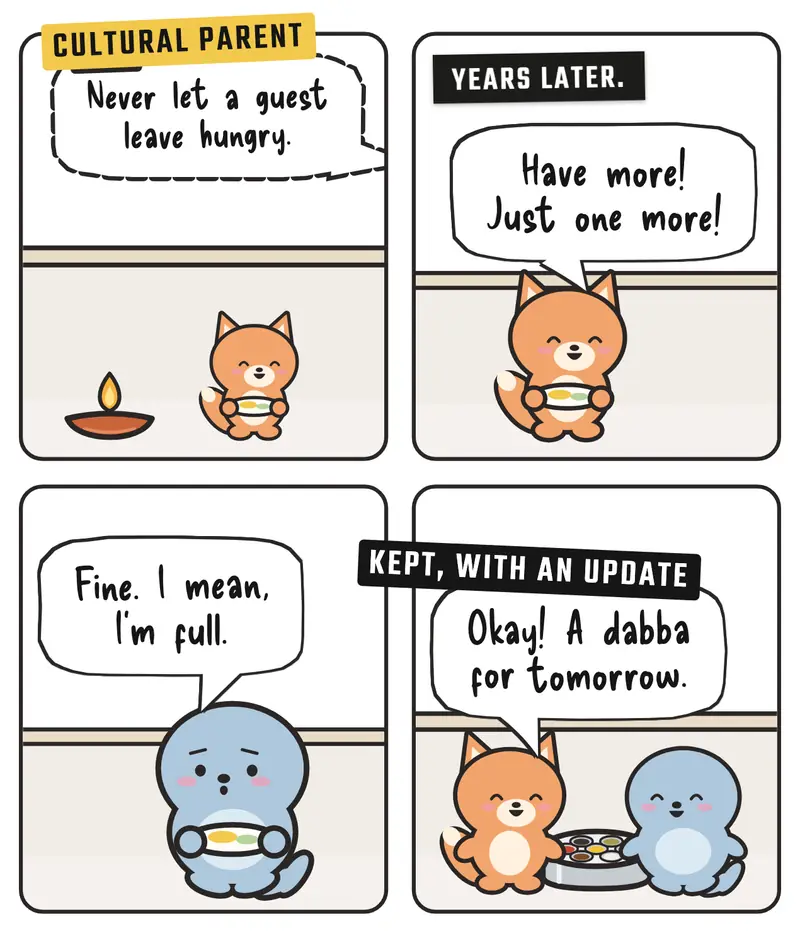
- Food and hospitality. "Never let a guest leave hungry." "Eat a little more, you look thin." Feeding people is care, and it can also be a rule that nobody, host or guest, is allowed to refuse.
- Festivals and elders. Touching elders' feet, who does which ritual, who travels home for Diwali, Eid or Christmas. These often carry the warmest parts of a culture: belonging, continuity, a place at the table.
Each of these can be lived happily. For a particular person, each can also carry an injunction underneath it.
How the Cultural Parent Shapes Scripts
In script terms, the Cultural Parent can supply many of the counter-injunctions, the spoken "shoulds" of a family, and it can reinforce the unspoken "don'ts" as well. TA 101 covers both in injunctions and counter-injunctions and in drivers.
As Hay (2019) reports, Drego's 1996 paper notes that the parts of a culture can pull together or against each other. A social slogan in the etiquette, such as "Work Hard" (a cultural slogan, not one of the five drivers), can strengthen a script injunction like Don't Feel. The feelings a group shares can also work against its own rules (Drego, 1996; Hay, 2019). Picture a family whose rule is "we don't make a fuss", and whose shared excitement turns every birthday into a fuss anyway.
As Hay (2019) reports, the paper drew on a five-year interdisciplinary study in which Drego interviewed 273 women about injunctions (Drego, 1996; Hay, 2019). Drego came to see that injunctions the women had absorbed from their culture, long before they could question them, kept them going along with their own subordination. She suggested thinking of this internalised culture as a Cultural Shadow within P1, the Parent in the Child: the version of the rules that a young child forms long before they can reason about them. She also showed how the myths a culture retells can reinforce these injunctions in families (Hay, 2019).
A child doesn't weigh a cultural message. They absorb it, and it can feel less like a rule and more like the way the world is. That's why a grown woman can fully disagree with "a good daughter-in-law never rests" and still feel guilty sitting down. Our post on growing up as the responsible one follows one version of this pattern.
Oppression and Regeneration: Culture as Pressure and as Resource
Drego's 1996 title pairs oppression with regeneration.
On the oppression side, Hay's account of Drego's model lists four warning signs of an unhealthy Cultural Parent: it resists change and punishes anyone who tries something new, takes over responsibility for people who don't need it, and holds on to power over others at any cost (Hay, 2019).
Turn that list around and you get our reading of a healthier Cultural Parent: one that lets traditions update, leaves room for the next generation's choices and shares power. Drego did not treat culture as the enemy. In later work she wrote about helping a child hold on to what is best in their family's traditions as protection against the flattening pull of global consumer culture, and in a 2005 keynote she praised what she saw as Scotland's Cultural Parent for its belief in equality and participation (Hay, 2019). A culture gives people language, ritual, food, music, faith, belonging and a long memory. After a death, a family that turns up with food every day, without being asked, can be exactly what someone needs.
Change, in her view, needs more than one person in therapy. She wrote that an oppressive Cultural Parent and its injunctions "must be cleansed at the individual level as well as at the group level" (Drego, 1996, quoted in Hay, 2019), and she called for group discussions among mothers, support among women and new programmes for families.
A Cultural Message Can Be Chosen
A traditional choice isn't the same thing as a scripted one. Someone who lives with their in-laws because they want to, keeps a fast because it means something to them, or meets a partner through their family with their eyes open, is not "stuck in the Cultural Parent". In TA terms, the question is whether the Adult is involved and whether other options feel possible, however modern or old the choice looks. TA's idea of autonomy is about awareness and choice, and a person can be autonomous and deeply traditional at once.
Noticing the Cultural Parent Around You
Here is a short noticing exercise. It is ours, not a tool from Drego's papers, and it stays at the level of noticing.
- Think of a few sayings that are common in families and communities you know, in any language: the ones repeated so often that nobody hears them any more.
- Pick one and look at the three layers Drego describes: the rule (etiquette), the how-to (technicalities) and the feeling it carries (character).
- Notice where you still hear it today: at home, at work, in films or in a family group chat.
That is as far as solo reflection needs to go. Tracing a saying back to your own early decisions, or working out which messages to keep and which to set down, is script work. It is safer with a trained therapist, who can stay with whatever comes up. If you'd like to explore that, a free 15-minute intro call is a gentle place to start.
How TA Therapy Works With Cultural Messages
In TA therapy, cultural messages usually come up through ordinary stories: a fight about a wedding date, a career decision, the guilt about moving cities. The work might include:
- Telling the voices apart. Is this my view, my mother's, or the family's? Naming whose sentence it is often takes some pressure off.
- Not making the family the villain. A good therapist won't push you to reject your culture, and won't push you to "just adjust" to it either. The aim is for your Adult to be part of the decision.
- Looking at the injunction underneath. If "log kya kahenge" carries a Don't Be You or Don't Belong, that is what the work focuses on, not the saying itself.
- Remembering the group. Drego's point that change also happens at the group level is a reminder that therapy is one piece. Conversations with family, and sometimes with parents themselves, can be part of it. If you have wondered about that, see suggesting therapy to your parents.
The Cultural Parent is a way of looking at patterns. It isn't a diagnosis, and it isn't a judgement of any culture or family.
Reflective Questions, Not a Quiz
There are no right answers, and you can skip any question.
- Which sayings do you hear most often in the families around you?
- Which cultural rule would you defend to anyone, because you value it?
- Who in your family has quietly updated a tradition? How did they do it?
- What part of your culture would you most want to pass on?
If one of these questions stirs up something heavy, take it to a therapist instead of working through it alone. If it brings up something heavy right now, Tele-MANAS is free on 14416 or 1-800-891-4416, 24x7.
Frequently Asked Questions
What is the Cultural Parent in transactional analysis?
The Cultural Parent is the part of the Parent ego state that carries a group's culture: its rules and values, its practical know-how and its shared feelings. Pearl Drego introduced it in the Transactional Analysis Journal in 1983. She drew on Eric Berne's three parts of group culture (etiquette, technicalities and character, which correspond to Parent, Adult and Child) and showed how a group's culture is carried inside each person's Parent.
Who is Pearl Drego?
Pearl Drego is an Indian transactional analyst who has written on ego states, permissions, culture, gender and spirituality since the 1970s. She introduced the Cultural Parent in 1983 and received the 2004 Eric Berne Memorial Award for her work on permission ritual therapy.
Is the Cultural Parent the same as the Parent ego state?
Not quite. The Parent ego state holds everything a person copied from parent figures. The Cultural Parent is the part of it that came from a whole group, such as a family line, a community or a society, and that many people around you share.
Is the Cultural Parent always negative?
No. Drego's 1996 paper was about both oppression and regeneration. A Cultural Parent can keep people stuck and punish change, and it can also carry belonging, ritual, care and wisdom. The TA question is whether a person can look at a cultural message with their Adult and choose what to do with it.
Did Pearl Drego win the Eric Berne Memorial Award for the Cultural Parent?
She won the Eric Berne Memorial Award in 2004, but the ITAA's list of winners gives the subject as permission ritual therapy, not the Cultural Parent.
If a rule you never chose keeps steering your big decisions, a free 15-minute intro call is a gentle place to start talking about it. You can also read how Transactional Analysis therapy works.
Sources
- Drego P. The Cultural Parent. Transactional Analysis Journal. 1983;13(4):224-227.
- Drego P. Cultural Parent oppression and regeneration. Transactional Analysis Journal. 1996;26(1):58-77.
- Hay J. TA contributions from India. International Journal of Transactional Analysis Research & Practice. 2019;10(2):101-119.
- Fregola C. Cultural Parent and learning in the knowledge society: a survey with students of the degree in primary education. International Journal of Transactional Analysis Research & Practice. 2021;12(2):33-37.
- Berne E. The Structure and Dynamics of Organizations and Groups. Philadelphia: Lippincott; 1963.
- International Transactional Analysis Association. Winners of the Eric Berne Memorial Scientific Award and the Eric Berne Memorial Award (PDF).
Related writings
12 min read
Ego States in Transactional Analysis: Parent, Adult, Child
Ego states in transactional analysis: Berne's Parent, Adult and Child, structural vs functional models, the five functional modes, contamination and examples.
11 min read
Life Scripts in Transactional Analysis and the Script Matrix
What a life script is in transactional analysis: Berne's idea, Steiner's script matrix, winning and losing scripts, the six script types and how scripts change.
8 min read
Therapy for Your Parents: How to Suggest It to Them
Want your mum or dad to try therapy? Why many Indian parents resist, what to say (with Hinglish lines), gentler first steps, and what to do if they say no.
Talk to a therapist about this
Transactional Analysis is the main way Dandelion works with individuals. Here is what it looks like in practice.
Transactional Analysis therapyYou can also look at online individual therapy.