
The 3 Ps of TA: Permission, Protection and Potency
By the Dandelion Reflect team
Last updated:
The 3 Ps of transactional analysis: what permission, protection and potency mean, who described them, how they work together and what they look like in therapy.
TL;DR: The 3 Ps of transactional analysis (TA) are permission, protection and potency, three conditions TA sees as necessary for someone to change an old script decision. Permission is the felt experience that something an early message forbade is now allowed. Protection is enough safety to try it. Potency is help that is strong and skilled enough to make a difference. Pat Crossman described permission and protection in 1966, and potency is usually traced to Claude Steiner (1968). In 2016 Keith Tudor revisited all three for present-day practice.
The 3 Ps are TA's short answer to the question "what does it take for a person to change?" Permission means being allowed to do what an old rule said you mustn't, such as feel, need or succeed. Protection means being safe enough to try. Potency means the help on offer is strong enough to work. If you have read about injunctions, the unspoken "don'ts" of childhood, you have already met permission: it is TA's answer to a "don't". This guide explains each P, where the idea came from, how the three work together, and what they can look like in therapy.
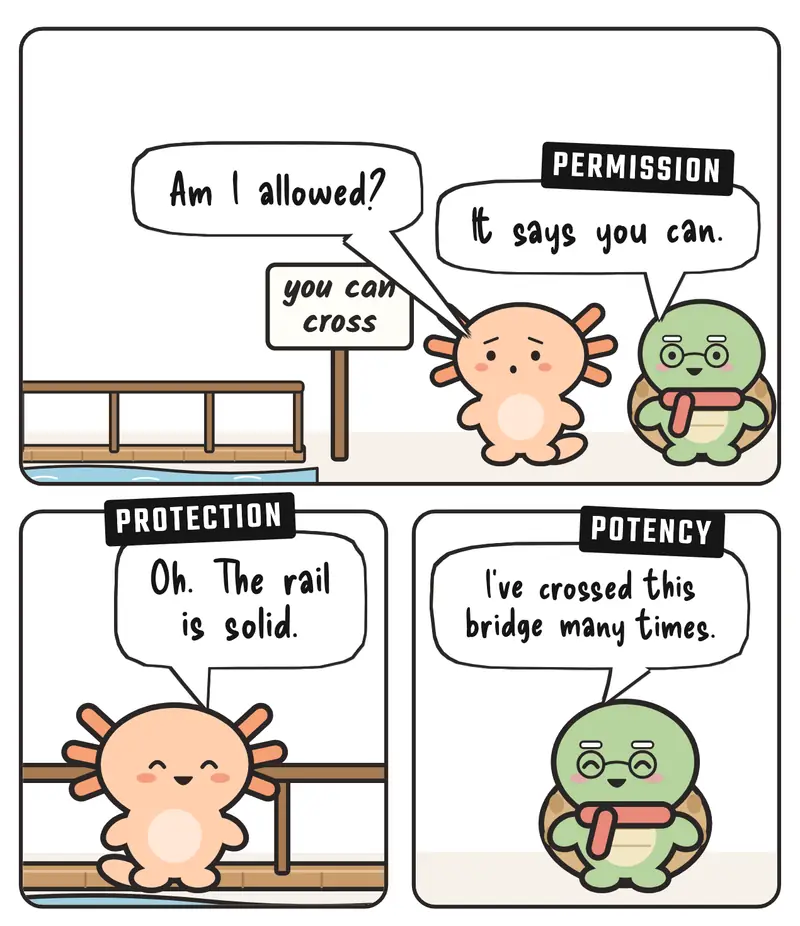
What Are the 3 Ps in Transactional Analysis?
The three Ps grew out of TA's script theory. A child who decided, under an early message, that it wasn't safe to feel or to be close made that decision for good reasons. Changing it as an adult takes more than a good argument. It needs three things.
- Permission: a lived, felt sense that what was forbidden is now allowed.
- Protection: enough safety, support and structure for the frightened, younger part of a person to try something new.
- Potency: help that is skilled and strong enough to stand up to the old message.
Permission and protection belong together. Potency is what makes either of them believable.
Where the 3 Ps Come From
The TA therapist Pat Crossman described permission and protection in a short 1966 paper in the Transactional Analysis Bulletin, "Permission and protection". Potency is usually traced to Claude Steiner, one of Eric Berne's early colleagues, and his 1968 paper "Transactional analysis as a treatment philosophy". TA writers have grouped the three together ever since.
In the classic picture, the ideas are drawn with ego states. The client's Child is still obeying an injunction that comes from their internal Parent. The therapist offers permission to the client's Child to stop obeying it, and protection while the Child takes the risk (Stewart & Joines, TA Today, Lifespace, 2012).
TA writers have kept returning to the idea since. In 2016 Keith Tudor published "Permission, Protection, and Potency: The Three Ps Reconsidered" in the Transactional Analysis Journal (Tudor, 2016), which is a good starting point for how the thinking has developed.
Permission
Permission is TA's answer to an injunction. If a child learned "Don't feel", "Don't be close" or "Don't make it", the adult needs an experience that tells them, deep down, that feeling, closeness or success is now allowed.
Permission isn't an instruction. "You should express your feelings more" is just one more rule, and a person can obey it the way they obeyed the old ones. Permission is closer to discovering that a forbidden thing can happen and the world doesn't end. Someone who learned "Don't feel" might cry in a session and find that the other person stays calm and stays with them. That experience, repeated, carries more weight than any amount of advice.
Permission can cover any of the injunctions, and TA writers have built tools around it. Laurie Hawkes, for example, set out a "permission wheel" (Hawkes, 2007). The injunctions guide has a section on injunctions, drivers and permissions that shows how the two connect.
Protection
Breaking an old rule can feel dangerous, even when it is plainly a good idea. The rule was there to keep a child safe, and the younger part of a person may expect real trouble, such as rejection, anger or being left. When someone starts to act on a new permission, that old fear can get louder before it settles. Under stress people also tend to slip back into familiar patterns, including the psychological games that confirmed the old rule in the first place.
Protection is what makes it safe enough to keep going. In the classic picture, it is the therapist's reliable support for the client's Child while the change takes hold. In everyday terms, protection in therapy can include:
- a clear contract, so both people know what the work is for;
- knowing what is confidential and what the limits of confidentiality are;
- pacing, so a big change isn't attempted before the support for it is in place;
- a plan for what to do if things get very hard between sessions;
- a therapist who works within an ethics code and has their own supervision.
Protection matters beyond the therapy room too. The European Association for Transactional Analysis lists protection among its five basic ethical principles, alongside respect, empowerment, responsibility and commitment in relationship (EATA). TA writers have also applied it to work with children: Leonard Campos wrote about building protection into script-prevention work (Campos, 1988).
Potency
Potency is the strength of the help on offer. For Steiner, it meant the therapist being able to make a real difference: having the skill to use methods that work and taking responsibility for using them. In the classic TA account, a client's Child will only trust a new permission if the person offering it seems at least as convincing as the old voice in their head (Stewart & Joines, 2012).
Potency isn't the same as dominance. In a contractual relationship built on mutual respect, a potent therapist is clear, competent and steady, and shares power with the client instead of taking it over. What potency looks like has been discussed from many angles in TA; Fanita English, for instance, wrote "Potency as a female therapist" in 1978 (English, 1978).
How the 3 Ps Work Together
Each P is weaker on its own.
- Permission without protection can be exciting for a while and then frightening. The person tries something new, the old fear floods in, and they decide never to try it again.
- Protection without permission is safe and kind, but nothing changes. The old rule stays in place, now with a comfortable cushion around it.
- Permission and protection without potency are well meant but too weak to shift a decision that has run a life for decades.
Together, the three give an old decision a real chance of being made again. That is the work the Gouldings called redecision, and it is one of the ways TA works with a life script.
The 3 Ps Outside Therapy
The same three ideas apply wherever one person helps another to grow. A parent who lets a child be angry (permission), stays calm and keeps them safe while they are (protection), and is grown-up enough to handle it (potency) is using all three. So is a manager who tells a new team member they are allowed to ask questions, makes sure a mistake won't cost them their job, and actually knows the work well enough to help. TA is practised in counselling, education and organisations as well as psychotherapy (ITAA), and the three Ps show up in all of them.
What the 3 Ps Can Look Like in TA Therapy
TA practice is "based upon mutual contracting for change" (ITAA), and the contract is where the three Ps start. In TA therapy you might notice:
- Potency in a therapist who is clear about what TA can and can't offer, explains how they work, and is open about their training.
- Protection in an agreed contract, a clear account of confidentiality and its limits, and a steady pace.
- Permission in the moments when something you learned not to do, such as disagreeing, crying or asking for something, happens in the room and is met well.
The aim is that, over time, a person can give themselves the permission and protection they once needed from someone else. Dandelion's page on Transactional Analysis describes what the work involves.
Reflective Questions, Not a Quiz
There is no score here. Notice which questions you'd rather skip.
- Which permission do you most wish someone had given you as a child?
- What do you fear would happen if you acted on it now?
- Who in your life has made you feel safe enough to try something new? What did they do?
- When you have changed something important before, what made the change stick?
- Which of the three Ps is hardest for you to offer other people?
If one of these brings up something heavy, please don't carry it alone. In India, Tele-MANAS (14416 or 1-800-891-4416) is the government's free tele-mental health line and runs 24x7. Outside India, contact your local emergency number or crisis line.
Frequently Asked Questions
What are the 3 Ps in transactional analysis?
The 3 Ps are permission, protection and potency. Permission is the felt experience that something an early message forbade is now allowed. Protection is enough safety and support to try it. Potency is help that is skilled and strong enough to make the change possible. TA sees all three as needed for someone to change an old script decision.
What is permission in transactional analysis?
Permission is TA's answer to an injunction, one of the unspoken "don't" messages of childhood. It is not advice or a new rule. It is an experience, often first in a trustworthy relationship, that feeling, being close, succeeding or needing is now allowed.
What is protection in TA?
Protection is the safety a person needs while they act against an old rule, because breaking it can feel frightening even when it is a good idea. In therapy it includes a clear contract, clear confidentiality limits, careful pacing and a therapist's ethical practice and supervision.
What is potency in transactional analysis?
Potency is the strength and skill of the help on offer. In TA it means a therapist who is able to make a real difference, uses methods that work and takes responsibility for using them, so that a new permission is more convincing than the old message.
Who came up with the 3 Ps?
Pat Crossman described permission and protection in 1966. Potency is usually traced to Claude Steiner's 1968 writing on TA as a treatment philosophy. Keith Tudor reconsidered all three in a 2016 paper in the Transactional Analysis Journal.
If you'd like to talk about what change could need for you, a free 15-minute intro call is a low-pressure place to start.
Sources
- Crossman P. Permission and protection. Transactional Analysis Bulletin. 1966;5(19):152-154.
- Steiner C. Transactional analysis as a treatment philosophy. Transactional Analysis Bulletin. 1968;7(27):61-64.
- Tudor K. Permission, protection, and potency: the three Ps reconsidered. Transactional Analysis Journal. 2016;46(1):50-62.
- Hawkes L. The permission wheel. Transactional Analysis Journal. 2007;37(3):210-217.
- Campos LP. Empowering children II: integrating protection into script prevention work. Transactional Analysis Journal. 1988;18(2):137-140.
- English F. Potency as a female therapist. Transactional Analysis Journal. 1978;8(4):297-299.
- Purpose, principles in numbers. European Association for Transactional Analysis.
- What is transactional analysis? International Transactional Analysis Association.
- Stewart I, Joines V. TA Today: A New Introduction to Transactional Analysis. 2nd ed. Lifespace; 2012.
Related writings
6 min read
12 Transactional Analysis Injunctions, With Examples
The 12 transactional analysis injunctions Bob and Mary Goulding described, from Don't Exist to Don't Feel: how each sounds, where it starts, how therapy helps.
12 min read
Psychological Games in Transactional Analysis: 10 Examples
Psychological games in transactional analysis: Berne's definition, Formula G, the three degrees of games and 10 games people play, with examples and ways out.
11 min read
Life Scripts in Transactional Analysis and the Script Matrix
What a life script is in transactional analysis: Berne's idea, Steiner's script matrix, winning and losing scripts, the six script types and how scripts change.
Talk to a therapist about this
Transactional Analysis is the main way Dandelion works with individuals. Here is what it looks like in practice.
Transactional Analysis therapyYou can also look at online individual therapy.